
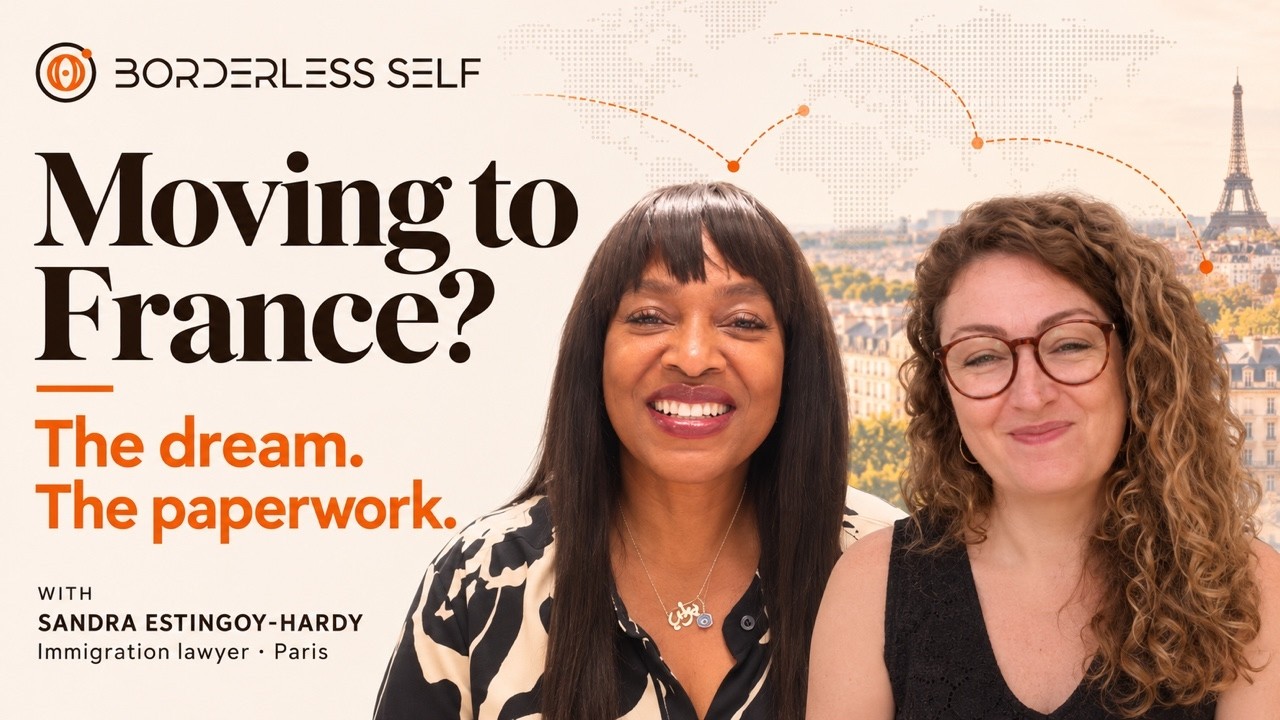
Borderless Self expert interviews · Sandra Estingoy-Hardy · Paris-based immigration lawyer
You can picture the apartment, the neighbourhood café and the version of yourself who buys excellent bread without rehearsing the sentence first. France would also like to know what you plan to do there.
Yoli Ngcakani’s interview with immigration lawyer Sandra Estingoy-Hardy explores moving to France as an artist, entrepreneur, employee, student or retiree. The thread running through it is simple: a convincing destination choice still needs to become a credible immigration project.
Watch the full interview and jump to a question
Watch on YouTube · Interview with Sandra Estingoy-Hardy · Hosted by Yoli Ngcakani
- 02:12 — Choosing a route
- 03:53 — Artists and creative professionals
- 06:48 — Founders and remote work
- 08:24 — When a job offer matters
- 10:02 — Investment and EU mobility
- 11:59 — The application
- 14:45 — French language
- 20:40 — Qualification recognition
- 24:42 — Study and retirement
- 29:10 — Avoiding mistakes
- 34:32 — Connecting with Sandra
What is France’s talent residence route?
Talent is a family of routes, not one universal visa for anyone with an impressive CV. The official France-Visas guidance covers different professional situations, including qualifying employees, economic projects and artistic activity, with distinct evidence requirements. Explore the official talent categories.
Sandra’s practical approach is to start with the person’s intended activity. Will you work for an employer, develop a business, pursue an artistic project or study? That answer changes the questions an adviser needs to ask.
The word “talent” should not make you rule yourself out—or assume you are in. Match your actual experience and proposed work to a category before building the application.
Can artists and creative professionals move to France?
The interview gives particular attention to creative careers. Sandra discusses the importance of showing both an existing practice and a credible project in France. The case needs more substance than a general desire to be inspired in Paris.
Useful preparation starts with a record of your work: commissions, performances, publications, exhibitions or other evidence relevant to your discipline. Then explain the French part of the plan, including proposed activity, relationships, resources and supporting documents appropriate to the route.
Do not manufacture a project because it sounds visa-friendly. Work out whether the real one is sufficiently developed, and ask what evidence would make it understandable to the person assessing the file.
Do all French work routes require a job offer?
No single answer covers employees, founders and independent creative work. An employment-based route is built around the qualifying employment; a business or artistic route has a different foundation.
Sandra encourages applicants to identify that foundation early. If the route depends on an employer, a strong personal profile does not replace the missing employment arrangement. If it depends on a business project, an attractive bank balance alone does not explain what the business will do.
The EU Blue Card also needs careful interpretation. A French residence document is not unrestricted permission to take any job anywhere in the European Union. Onward mobility has its own conditions and destination-country procedures.
Can you simply live in France and work remotely?
Do not assume that working for an overseas client makes every French residence category suitable. France-Visas states that private and tourist stays do not authorise professional activity, subject to the specific working-holiday exception it describes. Read the official private-stay guidance.
If remote work is part of your plan, describe the actual arrangement to a qualified adviser: who pays you, where the business is based, whether you are employed or self-employed, and what you will do while physically in France. A laptop is portable. Work permission is not automatically portable with it.
How important are French language skills and qualification recognition?
Sandra discusses language as both an administrative question and a practical part of settlement. Requirements vary by immigration stage and category; do not collapse the rules for an initial visa, a later residence card and citizenship into one supposed test.
Regulated professions create another separate question. Immigration permission and permission to practise a profession are not the same thing. A nurse or doctor needs to investigate professional recognition and any applicable registration requirements as well as the residence route.
For families, language planning is also about daily life: schools, appointments, landlords and a partner’s career. It belongs in the relocation budget and timetable, not in the list of things you will somehow sort out after arrival.
What mistakes can turn a promising move into an administrative headache?
Sandra returns to preparation and sequencing: knowing which application to make, keeping track of validation or renewal obligations, and securing credible accommodation evidence. A visa approval is a milestone, not the end of the paperwork.
Retirees should separately examine resources, health cover and tax. Property ownership does not itself confer residence. Students should verify the exact work rights attached to their status rather than assume limited employment permission also authorises any freelance activity.
Before you book the one-way ticket
- Write a concrete description of your intended activity in France.
- Identify the category that fits that activity.
- Gather evidence of experience, resources and the proposed project.
- Check professional recognition where relevant.
- Plan family, language and housing needs alongside the application.
- Separate immigration permission from tax and employment compliance.
For an employer-focused discussion of work authorisation, application evidence and family timing, continue with our interview with Fatou Babou. Sandra’s episode is the place to start when the question is how your creative or professional life could fit into France in the first place.
Guest and source notes
This article is an editorial companion to the full Borderless Self interview, based on its transcript. The guest’s observations and case examples are attributed throughout; summaries are not verbatim quotations. Official guidance was checked on 5 November 2026. Requirements and individual eligibility can change; verify the applicable route before applying.
Keep exploring
- France Needs Talent. Your Job Offer Still Needs a Visa Plan.
- Moving to Portugal? Choose the Right Visa Before the Dream Apartment.
Get the latest mobility reporting on Borderless Self on Substack, explore the Borderless Self relocation app, and watch more conversations on our YouTube channel.
