
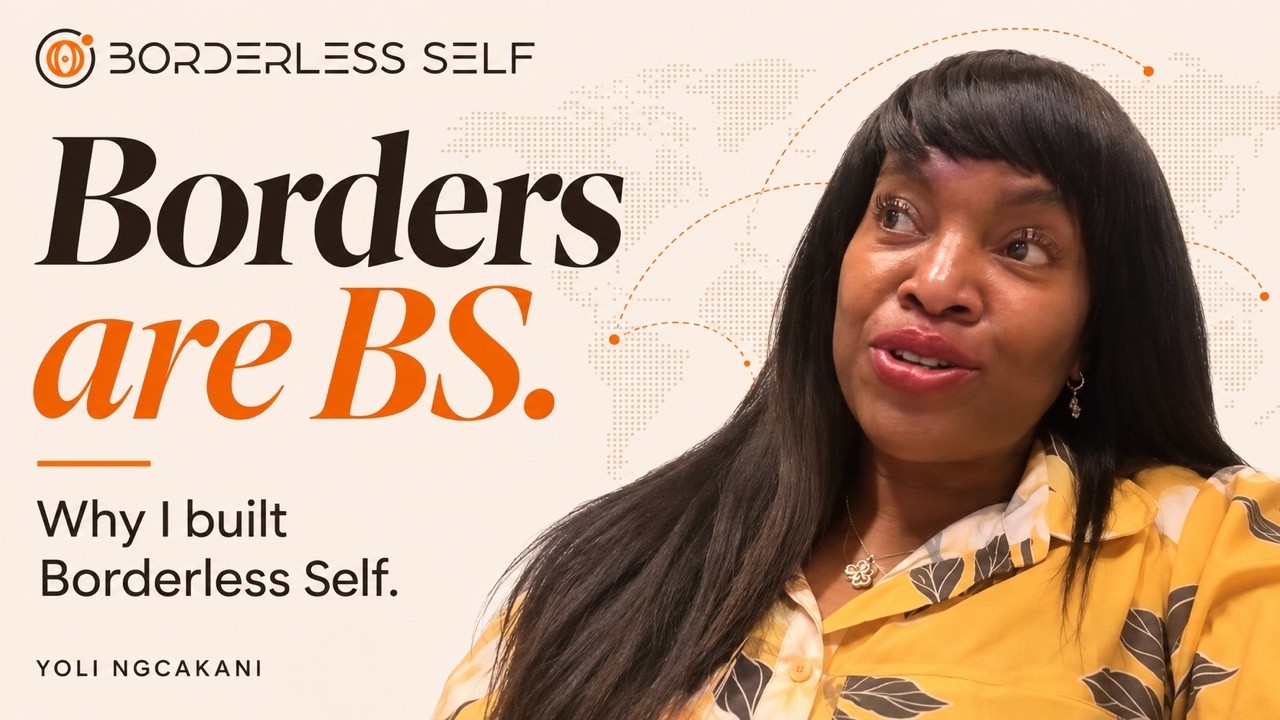
Borderless Self founder story · Yoli Ngcakani · Episode published 12 November 2026
Your birthplace is a fact. Why should it be your entire plan?
In Borders Are BS, Borderless Self founder Yoli Ngcakani connects her own childhood across countries to a bigger question: why do we treat the place someone happens to be born as the natural boundary of their possibilities? This is a personal essay about migration, identity and opportunity—not an instruction to ignore immigration law.
The central idea: a move abroad is often a decision about work, safety, education, family or belonging. Borderless Self grew from Yoli’s belief that people deserve better information and more agency when making that decision.
Watch the full episode
Watch on YouTube · Hosted by Yoli Ngcakani · Founder and host
Episode chapters: jump to the conversation
- 00:00 — Coming up: Borders are BS
- 00:23 — Borderless Self intro
- 00:44 — Why Borderless Self?
- 02:51 — Born into movement
- 03:46 — Humans have always moved
- 06:44 — Who drew the lines?
- 09:08 — The stories that opened the world
- 12:36 — The rhetoric. The demand.
- 17:48 — Follow the incentives
- 20:06 — More than lines on a map
- 22:26 — Why I built Borderless Self
- 23:22 — Continue the conversation
Why did Yoli Ngcakani create Borderless Self?
Yoli’s explanation starts long before an app or a podcast. Born in Zambia to South African parents who had left apartheid South Africa, she grew up in Kenya. Movement was part of family life before it became a professional interest. Being born in a place, she explains, did not automatically make her a citizen of it.
That experience separates three things that are often bundled together: where you are born, the citizenship you hold, and where you feel at home. They can overlap. They do not have to.
Borderless Self is her response to that gap: a place to explore the practical routes and human stories behind choosing a different life. The question is less “Which country wins?” and more “Where might my life work better—and what would getting there actually involve?” Watch the childhood story from 02:51.
What does “Borders Are BS” mean?
The title is provocative on purpose. Yoli challenges the idea that today’s political boundaries should be treated as timeless, inevitable or morally decisive in determining someone’s future. She is making an argument about human possibility, not claiming that passports and entry rules have disappeared.
That distinction matters. Believing people should have greater freedom to move is a political and ethical position. Having permission to enter, live or work in another country is a legal question. The dream still needs the paperwork.
Who drew the borders—and why does that question matter?
Yoli turns to Africa, India and Pakistan, the United States and Mexico, and changes in Europe to question how borders become familiar enough to seem permanent. These are prompts for thinking about history and power, rather than a comprehensive history of each boundary.
The personal connection is Kenya: her memories of pastoral and nomadic communities offer a different way of thinking about movement, land and belonging. A map can draw a clean line through a much messier human story.
The point for someone considering a move is not that all borders are alike. It is that the map is a political arrangement, while a person’s relationships, ambitions and identity may stretch across it. Watch “Who drew the lines?” at 06:44.
How do stories shape our willingness to live abroad?
Yoli remembers the worlds opened by Asterix and Obelix and Tintin. Those childhood adventures mattered because they made elsewhere imaginable. A place can become part of your future long before you know its visa categories.
That helps explain the tone of the show. Mobility is not only an administrative problem to solve. It is also curiosity: the possibility that a different environment might bring out a different part of you. The useful next step is to turn that curiosity into questions you can investigate.
Why can anti-immigration rhetoric coexist with demand for workers?
Drawing on her expert interviews, Yoli notices a tension: countries can sound resistant to immigration while employers still need particular skills. Public debate and recruitment needs are not always telling the same story.
This is her interpretation of the conversations she has had, not a claim that every country is open to every applicant. For a prospective migrant, the actionable question is specific: which employers, occupations and lawful routes fit your profile?
Our conversations on Australian employer sponsorship with Evan Bishop and New Zealand pathways with Paul Janssen explore what that looks like in practice.
Is moving abroad only about earning more?
No. Yoli describes mobility as a way people pursue safety, healthcare, education, family life, career growth and a stronger sense of possibility. Salary and tax are part of that calculation, but neither tells the whole story.
Her comparisons between places she has lived are personal experiences, not a promise that another household will save the same amount. A relocation budget needs housing, schooling, insurance, tax obligations and the cost of maintaining relationships across borders. A bigger salary can still buy a smaller life if the rest of the equation is wrong.
Five questions to ask before choosing your next country
- What am I trying to change? Name the problem: work, safety, family, opportunity, lifestyle or something else.
- Which places fit that goal? Compare your needs rather than chasing a universal “best country.”
- Which lawful pathway fits me? Separate permission to visit from permission to work or settle.
- Who else is moving with me? A partner’s career, children’s schooling and care responsibilities belong in the plan.
- What would belonging look like? Think about language, friendships and community alongside documents.
About this episode
Borders Are BS is a solo episode of The Borderless Self Show by founder and host Yoli Ngcakani. This article is an editorial companion to her recorded account. Personal recollections and opinions are attributed to her; the episode’s historical examples are not presented as a complete historical survey.
Keep exploring with Borderless Self
Get the mobility stories, practical questions and expert conversations in the Borderless Self newsletter. Explore the Borderless Self app on the App Store and subscribe to Borderless Self on YouTube for the next episode.
