

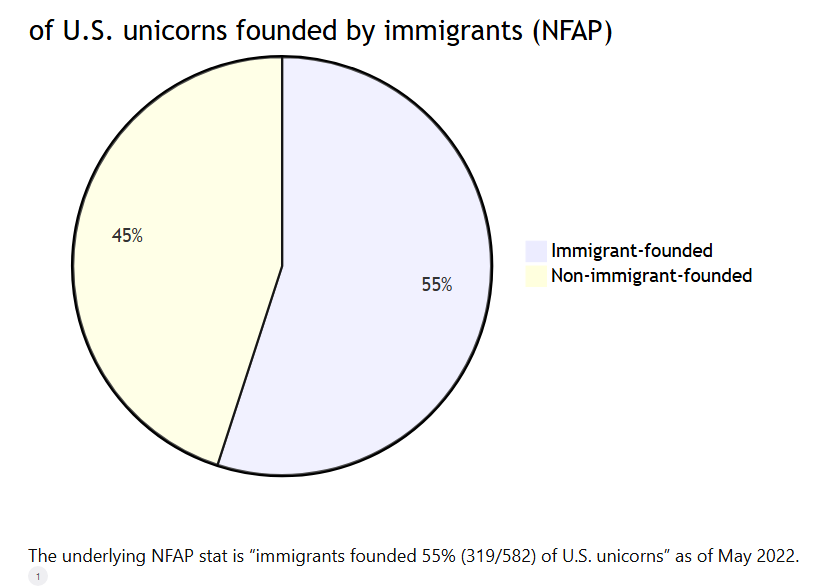
Relocation is often framed as a personal leap. In practice, it behaves more like a compounding mechanism: move into a higher-density market for capital, customers, and talent; convert prior credibility into new access; then build category-scale outcomes faster than you could from the periphery. The U.S. startup ecosystem is unusually “proof-driven” and unusually immigration-shaped—and the data is blunt. Immigrants founded 55% of U.S. unicorns as of May 2022 (319 of 582), and 64% of U.S. unicorns were founded by immigrants or their children.
That pattern isn’t limited to venture-backed startups. In the 2024 Fortune 500, 46% (230 companies) were founded by immigrants or their children. At the “new business” end of the pipeline, immigrants accounted for 24.2% of entrepreneurs in 2019 (Annual Business Survey-based research summarized by NBER). And on innovation itself, classic NBER research exploiting changes in the H‑1B program finds higher H‑1B admissions increase immigrant science-and-engineering employment and patenting, with limited evidence of displacement of natives.
This article translates those facts into a Borderless Stories lens: a “borderless person” mindset that treats borders as systems to learn, not identities to defend—then operationalizes that system literacy into mobility, optionality, and market access. BorderlessSelf’s own framing is simple: narratives are loud; systems are quiet; outcomes follow the quiet part.
Why relocation can unlock opportunity
A relocation that changes your trajectory usually does one of three things (often all three):
It moves you closer to decision-makers. Venture, enterprise buyers, platform partners, and deep technical talent still cluster. You can build world-class work remotely—but certain forms of trust, distribution, and deal flow still concentrate geographically.
It changes the “conversion rate” of your credibility. The same resume can mean different things in different markets. When UiPath incorporated in Delaware in 2015 and anchored executive operations in New York after beginning in Bucharest in 2005, it wasn’t only a legal shift—it was a distribution decision. Zendesk’s shift from Copenhagen (founded 2007) to Delaware (reincorporated 2009) is the same pattern: relocate the entity, not just the person.
It changes what problems are worth solving. The founder stories below repeatedly show that relocation isn’t just “where you live,” but “which problems you can afford to pursue” because of customer proximity, hiring depth, and funding norms.
The borderless person mindset is not optimism. It’s system literacy: knowing how immigration categories, corporate structures, and professional narratives interact—then sequencing moves to reduce friction. BorderlessSelf’s editorial stance is explicit: treat immigration less like a moral drama and more like a quiet system with rules, leverage points, and failure modes.
What the data says about immigrant leverage in U.S. tech
The macro story is measurable.
Immigrant founders are not a niche in U.S. venture; they’re a majority share of the top outcomes. NFAP’s 2022 study finds immigrants founded 55% of U.S. unicorns (319 of 582), and immigrants or their children founded 64%.
Immigrant roots extend into the largest U.S. companies. The American Immigration Council’s 2024 “New American Fortune 500” report finds 46% of Fortune 500 companies were founded by immigrants or their children.
Immigrants are a large share of entrepreneurs in general. NBER’s overview of immigrant entrepreneurship reports that immigrants accounted for 24.2% of entrepreneurs in 2019 (and notes the share rose from 2007 levels).
High-skill visa policy affects invention. NBER work on H‑1B reforms finds higher H‑1B admissions increase immigrant science-and-engineering employment and patenting by immigrant inventors in dependent cities/firms, with limited effects for natives in many specifications.
Immigrant-founder casebook
Two notes before the stories:
First, “exact visa used” is rarely public. Where not explicitly documented, the pathway below is likely/inferred based on the founder’s timeline and the common mechanics of U.S. work authorization for executives, students, and entrepreneurs.
Second, founders often move through multiple statuses over time (e.g., student → work visa → permanent residence). The table and vignettes call out the most plausible “bridge” status that made the relocation workable.
Founder table
| Name | Origin country | Company | Year founded | Status | Relocation / visa pathway (likely or documented) | Key impact metric |
|---|---|---|---|---|---|---|
| Daniel Dines | Romania | UiPath | 2005 | Exit (IPO) | Likely L‑1A executive transfer after U.S. incorporation (inferred) | Founded in Bucharest (2005), Delaware-incorporated (2015), HQ New York; 2,863 employees as of Jan 31, 2021 |
| Ion Stoica | Romania | Databricks | 2013 | Unicorn | Likely F‑1/H‑1B/EB track via academia (inferred) | $1B Series G (2021) valued Databricks at $28B post-money |
| Mikkel Svane | Denmark | Zendesk | 2007 | Exit (IPO) | Likely L‑1A/E‑2 bridge during Denmark→Delaware shift (inferred) | Founded in Copenhagen (2007), reincorporated Delaware (2009) |
| Vladimir (Vlad) Tenev | Bulgaria | Robinhood | 2013 | Exit (IPO) | Family-based relocation as child (exact unknown); later U.S. career | Robinhood founded in 2013 |
| Garrett Camp | Canada | Uber | 2009 | Exit (IPO) | TN for early employment is common for Canadians, but not for self-employment; founders often pivot to O‑1/E‑2/LPR (inferred) | Uber founded 2009; S‑1 shows scale metrics incl. 93M MAPCs and 17M trips/day (as of 2018/2019 context) |
| Peter Szulczewski | Poland → Canada | Wish (ContextLogic) | 2010 | Exit (IPO) | Likely employer-sponsored work authorization (e.g., H‑1B) then founder status shift (inferred) | Wish co-founded by Waterloo alumni; reported 31M active users and ~400 employees (2015 context) |
| Ryan Cohen | Canada | Chewy | 2011 | Exit (acquired; later IPO) | E‑2 investor is a common founder route for eligible nationalities; exact status unknown (inferred) | Chewy launched 2011; delivered 100M+ orders since 2011; PetSmart acquisition noted in filings |
| Shlomo Kramer | Israel | Imperva | 2002 | Exit (acquired) | High-likelihood L‑1 (intracompany transfer) given documented transition from Imperva Ltd. (Israel) to U.S. entity (inferred) | Thoma Bravo deal valued Imperva ~$2.1B (official press release) |
| Nir Zuk | Israel | Palo Alto Networks | 2005 | Exit (IPO) | Likely O‑1/H‑1B early tech career → later permanent residence; exact unknown (inferred) | Company-founded-in-2005 claim appears in company release; Zuk states he was born in Israel |
| Assaf Rappaport | Israel | Wiz | 2020 | Unicorn | Likely O‑1 and/or E‑2 and/or IER pathways for founders; exact unknown (inferred) | Wiz reports 50% of Fortune 100 as customers, 5M workloads protected, 230B files scanned daily |
| Des Traynor | Ireland | Intercom | 2011 | Unicorn | Likely E‑2 (Ireland eligible) or O‑1 after early traction; exact unknown (inferred) | Intercom described as a $1.3B company with 25,000+ customers; team moved to SF soon after founding |
| Tope Awotona | Nigeria | Calendly | 2013 | Unicorn | Immigrated as a teenager (family route likely); later U.S.-based founder | $350M investment valued Calendly at $3B+ and cited $70M recurring subscription revenue (2020) |
The founder stories

Daniel Dines (Romania → U.S.) built UiPath with a “dual-center” reality baked into the company. UiPath states it was founded in Bucharest in 2005 and later incorporated in Delaware in 2015, with principal executive offices in New York. That pattern—Eastern European engineering leverage plus U.S. market access—shows up repeatedly in modern enterprise software. As of Jan 31, 2021, UiPath reported 2,863 full-time employees, spanning New York and Bucharest. Likely pathway: an executive transfer mechanism such as L‑1A is common when a founder leads an established foreign operation and then stands up a U.S. office or affiliate (inferred; exact visa not public).

Ion Stoica (Romania → U.S.) is explicit about being a cross-domain operator: UC Berkeley professor and co-founder of multiple companies, including Databricks (2013). Databricks’ own founders page lists Stoica among its founding team. Databricks later raised a $1B Series G at a $28B post-money valuation (2021). Likely pathway: academic founders often arrive as students and transition through employer-sponsored work authorization (e.g., H‑1B) and employment-based permanent residence (inferred).

Mikkel Svane (Denmark → U.S.) built Zendesk with the corporate move visible in the filing itself: founded in Copenhagen (2007) and reincorporated in Delaware (2009). This is the “entity relocation” pattern—move the legal center of gravity toward the market you’re scaling into. Likely pathway: founders shifting an existing foreign company into the U.S. often fit L‑1A (executive transfer) or E‑2 (treaty investor) depending on capital structure and timing (inferred).

Vlad Tenev (Bulgaria → U.S.) represents a different mobility type: childhood relocation that later becomes professional leverage. Robinhood reports it was founded in 2013. Robinhood’s board bio ties Tenev directly to that founding moment. His move from Bulgaria to the U.S. is broadly reported as a family migration (exact status usually private).

Garrett Camp (Canada → U.S.) shows the “pain point imported into a new market” dynamic. The University of Calgary describes him as a Canadian entrepreneur and notes he co-founded Uber in 2009, living in San Francisco. Uber’s S‑1/A states it was founded in 2009 and incorporated as Ubercab, Inc. in July 2010. For Canadians, TN status can be a fast employment route, but it explicitly restricts self-employment—one reason many founders eventually use other categories (e.g., O‑1, E‑2, or permanent residence).

Peter Szulczewski (Poland → Canada → U.S.) illustrates a common mid-career inflection: leave a platform company, take conversion risk. ContextLogic’s S‑1 lists Szulczewski as founder/CEO, with prior experience at Google, and ties his leadership to the company’s inception period. A University of Waterloo profile captures the “why leave Google” logic—impact and speed—and reports Wish’s scale at the time (31M active users and ~400 employees in its California office). Likely pathway: many founders who first worked at a U.S. tech firm are initially covered by employer-sponsored categories like H‑1B, then later shift status as founders or permanent residents (inferred).

Ryan Cohen (Canada → U.S.) is a case where the “exit” validates the relocation. Chewy’s S‑1 emphasizes the company launched in 2011 and reports operating scale markers such as delivering over 100M orders since 2011. Chewy’s investor news release (PetSmart acquisition announcement) states Chewy was founded in 2011 by Ryan Cohen and Michael Day. Canadians can be eligible for E‑2 treaty investor status, which is a common entrepreneur bridge (nonimmigrant) when the founder is investing and controlling a U.S. enterprise (exact visa not public; inferred).

Shlomo Kramer (Israel → U.S.) is one of the rare cases where relocation mechanics leak into primary documents. Imperva’s S‑1 includes an exhibit describing a transition of Kramer’s employment from Imperva, Ltd. (Israel) to the U.S. company, including relocation support—strong evidence of a structured corporate move. Imperva later announced a Thoma Bravo acquisition agreement valuing the deal at approximately $2.1B. That Israel→U.S. “company-with-foreign-office” pattern aligns closely with L‑1A logic (executive transfer), though the exact filing category is not specified publicly.

Nir Zuk (Israel → U.S.) is explicit about origin: in Sequoia’s published conversation, he states he was born in Israel and is the founder/CTO of Palo Alto Networks. Palo Alto Networks’ release also states he founded the company in 2005. Founders with deep technical leadership sometimes fit O‑1 (extraordinary ability) if their record is strong; others begin on employer categories like H‑1B earlier in career (exact unknown; inferred).

Assaf Rappaport (Israel → U.S.) and Wiz highlight a modern form of “split headquarters”: leadership and go-to-market in the U.S., engineering gravity in Israel. Wiz’s About page lists Rappaport (CEO), and other leadership, and reports unusually concrete scale signals for a private company: 50% of Fortune 100 as customers, 5M workloads protected, and 230B files scanned daily. For Israeli founders post‑2019, both O‑1 and E‑2 can appear as founder-friendly bridges (depending on ownership and investment), and the International Entrepreneur Rule can be relevant in some cases (all inferred; exact status not public).

Des Traynor (Ireland → U.S.) and Intercom show relocation as a deliberate early-company act: Intercom’s own chairman bio says that soon after Intercom was founded, the team moved to San Francisco and opened headquarters there. Forbes describes Intercom as a $1.3B company with 25,000+ customers and notes it crossed $100M in revenue. Ireland’s eligibility for E‑2 (treaty investor) makes it one plausible founder route; O‑1 is another for founders with strong evidence of impact (inferred).

Tope Awotona (Nigeria → U.S.) is a “mid-career builder” archetype: sales background, then startup execution. Calendly’s major 2021 growth round was described as valuing the company at over $3B and cited $70M in recurring subscription revenue for 2020. His immigration is widely described as a family move when he was a teenager (specific immigration category not typically public).
Visa pathways that show up repeatedly
This is not legal advice. It is a systems map: the recurring “pipes” through which borderless careers actually flow. BorderlessSelf’s frame here matters: the system is the story.
Visa pathway table
| Pathway | What it’s commonly used for | Core eligibility (official framing) | Practical constraints |
|---|---|---|---|
| H‑1B (specialty occupation) | Mid-career tech roles via U.S. employer sponsorship | Specialty occupation work; employer petition and LCA process | Cap/lottery dynamics; employer dependence; not designed for self-employment |
| O‑1A (extraordinary ability) | High-achievement founders/execs who can document impact | Extraordinary ability in sciences/education/business/etc. | Evidence-heavy; often needs agent/employer structure; renewals and itinerary requirements can be complex |
| L‑1A (intracompany executive/manager) | Founders/executives moving an existing foreign company into the U.S. (incl. “new office”) | Transfer executive/manager from affiliated foreign office to U.S. office; can also come to establish a U.S. office | Requires qualifying corporate relationship and prior foreign employment; timing matters |
| TN (USMCA/NAFTA professional) | Faster entry for Canadian/Mexican professionals with a job offer | Must work in a qualifying profession for a prearranged employer role; self-employment not permitted | Founder usage is constrained; good for employment, tricky for “I sponsor myself” |
| E‑2 (treaty investor) | Founder-investors from treaty countries who control and fund a U.S. business | National of treaty country; substantial investment in a U.S. enterprise | Nonimmigrant (not a direct green card); depends on treaty nationality; investment and operational requirements |
| IER (International Entrepreneur Rule) | Some startup founders without a conventional visa category | DHS parole on case-by-case basis for entrepreneurs with significant public benefit potential | Parole is discretionary; not a visa; requires meeting threshold criteria and ongoing compliance |
| EB‑1 (employment-based first preference) | Permanent residence for extraordinary ability, outstanding researchers, multinational execs | EB‑1 categories include extraordinary ability, outstanding professor/researcher, multinational manager/executive | High evidentiary bar; timing and quota/backlog can matter by country |
| EB‑2 NIW (national interest waiver) | Permanent residence for advanced degree/exceptional ability with U.S. national interest case | USCIS publishes policy guidance for NIW evaluation under EB‑2 | Evidence-heavy; “national interest” framing must be coherent and documented |
| EB‑5 (immigrant investor) | Permanent residence through qualifying investment and job creation | Invest in U.S. commercial enterprise and create/preserve 10 full-time jobs | Capital intensity; compliance and timing complexity |
| E‑3 (Australia specialty occupation) | H‑1B-like pathway for Australians | Australian nationals in specialty occupations | Nationality-limited; still requires specialty occupation and sponsorship mechanics |
A practical reminder: the U.S. still lacks a simple statutory “startup visa” option, which is why founders often stitch together the above categories.
Practical checklist for mid-career relocators
This is the borderless move: deliberate, evidence-backed, and reversible where possible.
Clarify the relocation thesis. Pick one explicit outcome you’re buying with the move: (a) access to a specific labor market, (b) access to capital, (c) proximity to customers, or (d) regulatory arbitrage. If you can’t name the outcome, you’re just changing scenery.
Inventory credibility you can transfer. Collect proof-of-work: shipped products, measurable revenue impact, patents/papers, press, open-source contributions, references. O‑1, EB‑1, and NIW pathways are evidence machines; even employer routes become easier with visible proof.
Map immigration as a sequence, not a single bet. Many founders and operators move through stages (student → employer → founder; foreign company → L‑1A; investor → E‑2; founder parole → longer-term residence). The point is not to “pick the perfect visa,” but to pick the next legal step that preserves momentum.
Design for sponsor reality. If you are pursuing H‑1B/TN/E‑3, you need an employer model that fits the rules (TN in particular disallows self-employment).
Treat corporate structure as mobility infrastructure. Multiple stories above show the “Delaware flip” / U.S. HQ move as part of scaling (UiPath, Zendesk). If you’re founding, build the company so it can sponsor, hire, and comply—not just build product.
Run the personal-operational numbers. Relocation is not only visa cost; it’s opportunity cost: runway, healthcare, tax complexity, and family constraints. Investors and employers assume you’ve done this math.
Build a local surface area before you land. Create conversations with target-market people (operators, recruiters, angels, partners). Borderless careers compound through adjacency; you can manufacture adjacency with deliberate outreach.
Get real counsel when stakes are high. Because categories like O‑1, EB‑1, NIW, and IER can hinge on subtle evidence and narrative structure, professional advice can be outcome-determinative. (That’s not hype; it’s the nature of evidence-based adjudication.)
Relocation doesn’t automatically create opportunity. But the universe of evidence says it can change the probability curve—especially when you approach it like a borderless person: systems-first, sequence-driven, and relentlessly specific about what the move is purchasing.
