

Short answer: for a lot of people, yes. A recent thread on Reddit’s r/AmerExit asked people who had left the US a simple question, and the answers kept pointing at the same thing: the stress they carried every day only became visible once it was gone.
In this article
- What a 1,000+ upvote Reddit thread says about stress after leaving the US
- How long people say it took for their stress to drop
- The everyday things people name as the cause
- The honest downsides
- Seven questions to ask yourself about your own country
The post that started it
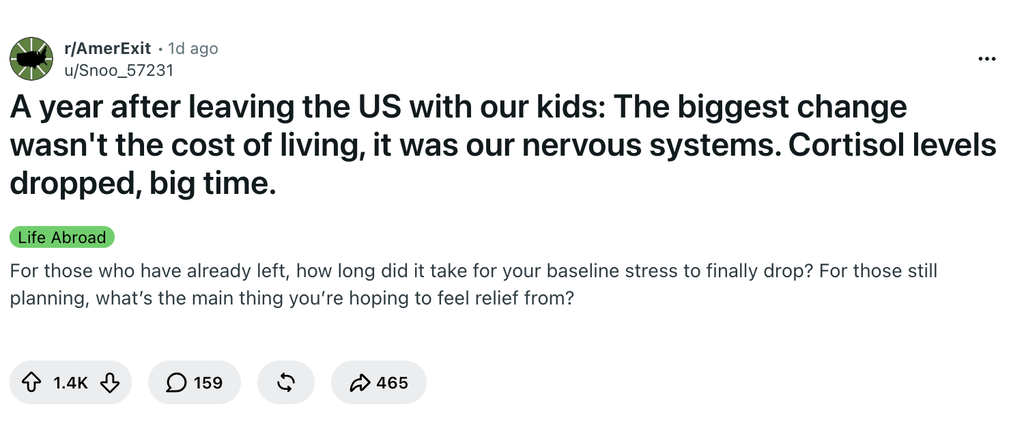
A year after leaving the US with their kids, one poster on r/AmerExit wrote that the biggest change was not the cost of living. It was their nervous system. In the poster’s words, “cortisol levels dropped, big time.”
The post ended with two questions. For people who have already left: how long did it take for your baseline stress to finally drop? For people still planning: what is the main thing you hope to feel relief from?
The thread passed 1,000 upvotes and more than 100 comments within a day. That tells you the question touched something.
How long does it take for stress to drop after moving abroad?
The answers varied a lot. None of them are medical measurements. They are people describing how they felt. But the range is useful if you are planning a move.
- Within the first week. A commenter who moved to Canada said it was within the week, helped by having no change of time zone or language to adjust to.
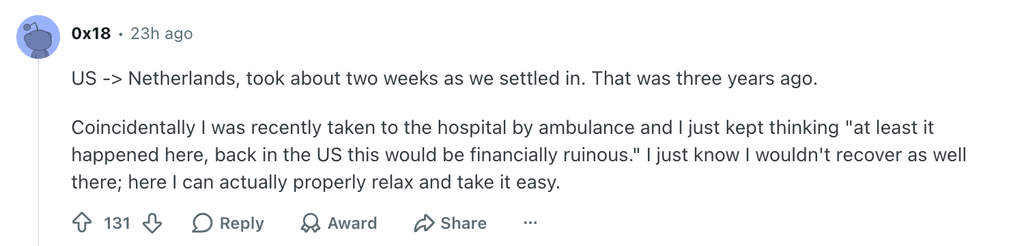
- About two weeks. A commenter who moved to the Netherlands said it took about two weeks while they settled in.
- Three to four weeks. A commenter who moved to Naples in August said their anxiety “dropped dramatically” over about 3-4 weeks, once the initial rush of getting acquainted and putting their daughters in school was over.
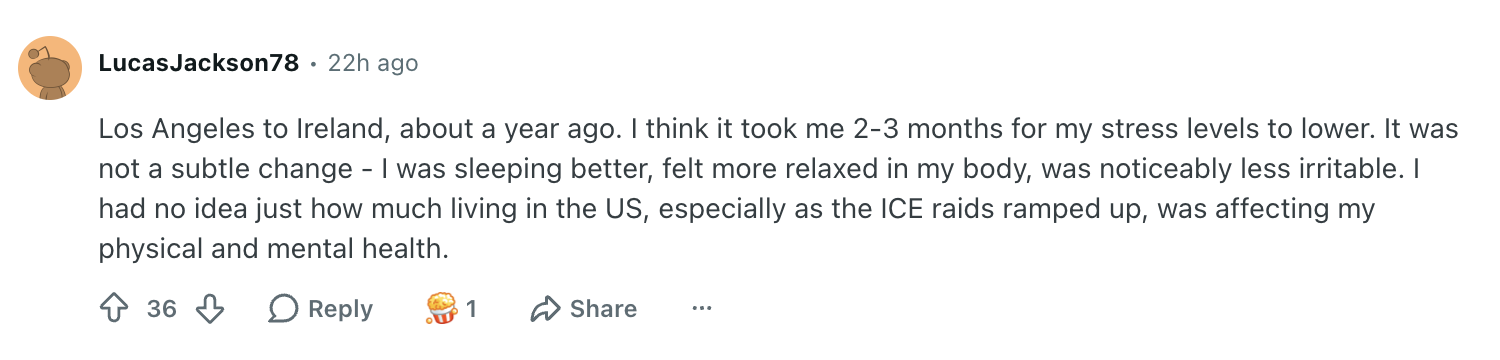
- Two to three months. A commenter who moved from Los Angeles to Ireland said it took 2-3 months, and that it was “not a subtle change.”
- Four to five months. A commenter who has been in Spain for a year said it took about 4-5 months of feeling settled, with a new “normal routine,” before they felt how calm they had become.
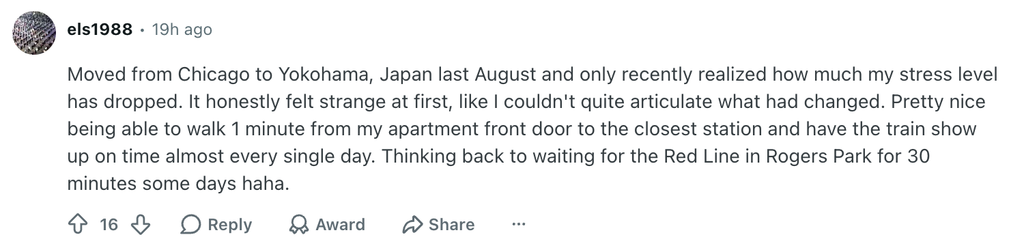
- Only in hindsight. A commenter who moved from Chicago to Yokohama said they “only recently realized” how much their stress had dropped. It felt strange at first, like they could not quite say what had changed.
The pattern: the first weeks are busy and can be stressful in their own way. The drop often shows up after the logistics settle, and some people only notice it when they compare their old days with their new ones.
What people say was actually making them sick
Nobody in the thread blamed one big thing. They described a steady background load that they had stopped noticing. Here is what came up.
Safety worries that never switch off
The Canada commenter said they “didn’t realize how stressed we perpetually were about things like guns and ICE until it was no longer a part of our daily life.” Another poster, who left for Japan this summer, wrote that they have no fear of guns or ICE encounters any more.
The cost of getting sick
A commenter in the Netherlands was recently taken to hospital by ambulance. They wrote that they kept thinking, “at least it happened here, back in the US this would be financially ruinous.” They added that here they can “properly relax and take it easy.” Worrying about the bill can make recovery harder, and that is the point they were making.
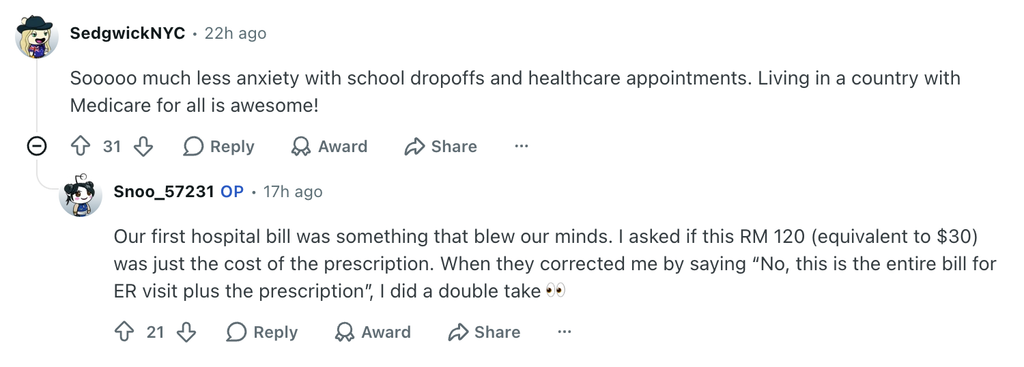
The original poster added a story of their own. Their first hospital bill abroad was RM 120, about $30. They asked whether that was only the prescription. They were told it was the entire bill for the ER visit plus the prescription. Another commenter, in a country they described as having “Medicare for all,” said they have “so much less anxiety” about school drop-offs and health-care appointments.
Daily friction
The commenter in Yokohama described walking one minute from their front door to the station and having the train show up on time almost every day. They compared it to waiting 30 minutes for the Red Line in Chicago. Small daily frictions add up, and removing them can change how a day feels.
Feeling welcome
One commenter, a Black woman now living in Mexico, said the way she is treated there is “night and day” compared with the US. She said she had not realized how much the microaggressions were making her uncomfortable just leaving the house.
When the body notices
Some of the most striking comments were physical. One commenter, now six years in Antigua and Barbuda, said stress had given them painful, bleeding eczema that a dermatologist could not do much about. They had never had it before. They wrote that “the moment I moved to the Caribbean, it disappeared and never came back.” They also said they lost 100 lbs and that their family is “happier and healthier.”
Another commenter said that when they lived in Spain they lost weight, had more energy and felt healthier. A third, also in Spain, said their spouse, who works in the music industry, can now listen to whole albums for fun because their brains are no longer “taken up with The Horrors every waking moment.” That commenter limits US news to 10 minutes a day and said this has helped “immensely.”
These are individual stories, and one person’s skin condition is not proof of anything. But they show how people describe stress: not as a mood, but as something their bodies were carrying.
Money pressure
The Japan poster said they make a quarter of what they used to, but daily costs are so low that they and their wife can travel, eat out and go to events “without worry.” Lower income, lower pressure. That will not be true for everyone, so check your own numbers before you assume it.




The honest downsides
Leaving is not a cure, and the thread does not pretend it is.
- The first weeks can be hard. The Naples commenter said much of the early stress came from getting acquainted with everything and settling their daughters into school.
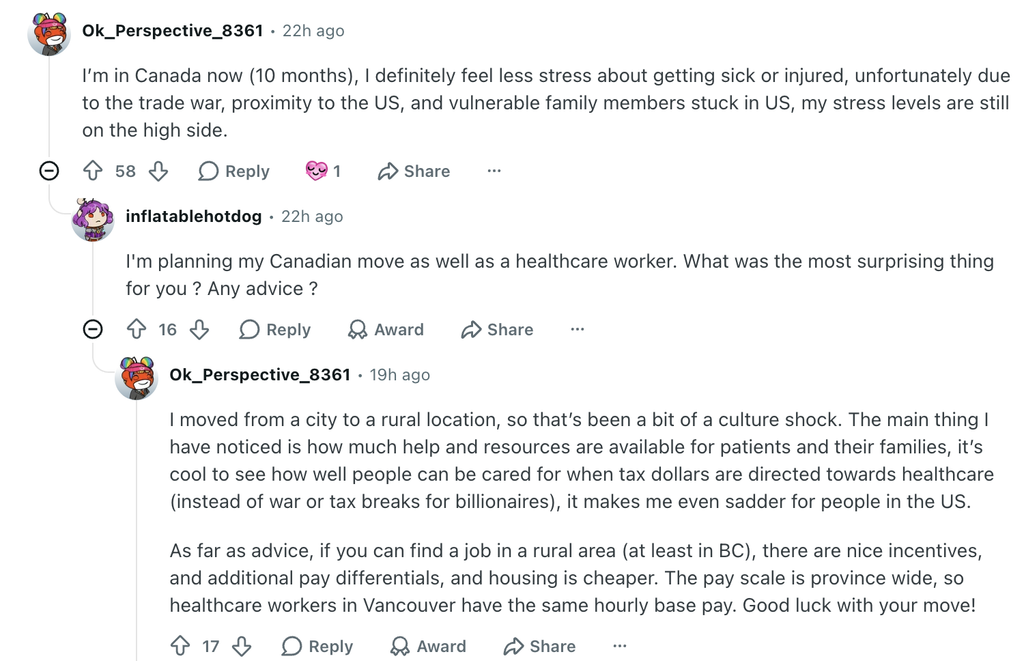
- Some stress follows you. A commenter who has lived in Canada for 10 months said they feel less stress about getting sick or injured, but that, because of the trade war, the closeness to the US and vulnerable family members still there, their stress levels are “still on the high side.”
- You carry things with you. The Japan poster wrote that “there is no way to escape the tragedy of life back home” and that leaving changes nothing for the people affected by American policies.
- Burnout can last. The same poster, an activist since their teens, said total burnout from US life left them unable to be useful in movements any more. Relief and guilt can arrive together.
- It was one thread. These are self-selected, anonymous accounts from people who chose to leave and chose to answer. They are real experiences, not a study. If you are struggling with stress, anxiety or sleep, a doctor or therapist is the right place to start, wherever you live.
Is it your country, or is it you?
You cannot answer that with a screenshot. But you can ask better questions. Be honest with yourself on these.
- Do you tense up before you leave the house, drive, or open the news?
- Do money worries, especially medical costs, show up in your thoughts most days?
- Do you feel better on holiday in specific places, and worse when you return?
- Do you feel welcome, safe and respected where you live?
- Do you lose time to commutes, waiting and delays that you cannot fix?
- Has your sleep or your mood changed, and you cannot point to one reason?
- If you took away the logistics, which feeling would you most hope to leave behind?
That last question is the one the original poster asked people who are still planning: what is the main thing you hope to feel relief from? Write your answer down. It is a good test of whether you are moving toward something or only away from something.
My Experience:
When I moved from Canada to the United States I gained about 40 pounds. It was largely due to the fact that I went from walking and using public transportation daily to sitting in a car for the first time in Seattle. I never found a need to drive in Toronto because they have a pretty excellent public transportation system. When I arrived in Seattle it became clear that I was going to need to drive because there was no subway system. Sitting in traffic in a daily commute 3 months in i had packed on extra pounds. It wasn’t until I moved from the United States to Mexico that I experienced what many of these commenters also experienced. First I lost weight but more than that I lost a psychological weight I had no idea I had been carrying until I had been in Mexico a few weeks and realized I hadn’t thought about being black for weeks. To explain it this way doesnt do it justice – its so difficult to explain the mind body connection and when you physically experience the detoxing of a mental state. It was wonderful the Mayan people of the Riviera were so welcoming and for the first time since I had come to North America 20 years ago I felt very much at home. It was very apparent as well that that all food is not created equal. When I stopped eating American brands I saw a remarkable difference in my health. It was very easy to do so because in Mexico American food has these giant warning labels for excessive sugar, salt, chemical, GMO, preservatives or banned substances. That was one of the most shocking things, when you walk down a grocery aisle in Mexico it becomes very apparent that many American foods are problematic and the Mexican government goes out of their way to warn their citizens. Practically it was also obviously beneficial to be in a place with an abundance of fresh fruits and fresh affordable seafood. I lived in Mexico for 4 years and it was the only place where I could get my teeth cleaned every 2-3 months because it was so affordable. I also benefitted from being introduced to raw cacao, pure honey and all manner of native practices that just enhanced my well-being. About a year in I was so well rested and rejuvenated I finally understood the Tax of living in New York and Seattle had on my body and mental health.
What to do next
If this thread sounds familiar, you do not have to decide anything today. Start by finding out what relief would look like for you, then compare countries on the things that matter to that answer: cost, health care, safety, visa route and how welcome you will be.
That is what we built Borderless Self to help with. Check out Borderless Self the app that matches your experience and skills with the countries where they’re in demand.
Your turn: how long did it take for your stress to drop after you moved, or what are you hoping to feel relief from? Tell us in the comments. [ r/AmerExit thread]
Frequently asked questions
How long does it take for stress to drop after moving abroad?
It varies. In the r/AmerExit thread, people reported anywhere from within the first week to two weeks, three to four weeks, two to three months, or four to five months. Some only noticed in hindsight. These are personal accounts, not clinical data.
Can where you live affect your mental and physical health?
Many people in the thread say so. They describe better sleep, less irritability and a more relaxed body after moving. Cost pressure, safety worries, health-care costs, commutes and how welcome you feel can all add to a constant background load. If you are worried about your health, speak to a qualified professional.
Is moving abroad a cure for stress?
No. Moving has its own stress, including visas, schools and learning a new place. Several people said the first weeks were hard before things leveled off.
Is this based on research?
No. This article draws on one Reddit thread of personal stories. It is not medical advice or a scientific study.
Disclaimer: this article shares personal experiences and is not medical advice. Quotes come from public comments on Reddit’s r/AmerExit and are attributed to the usernames shown in the screenshots.
