




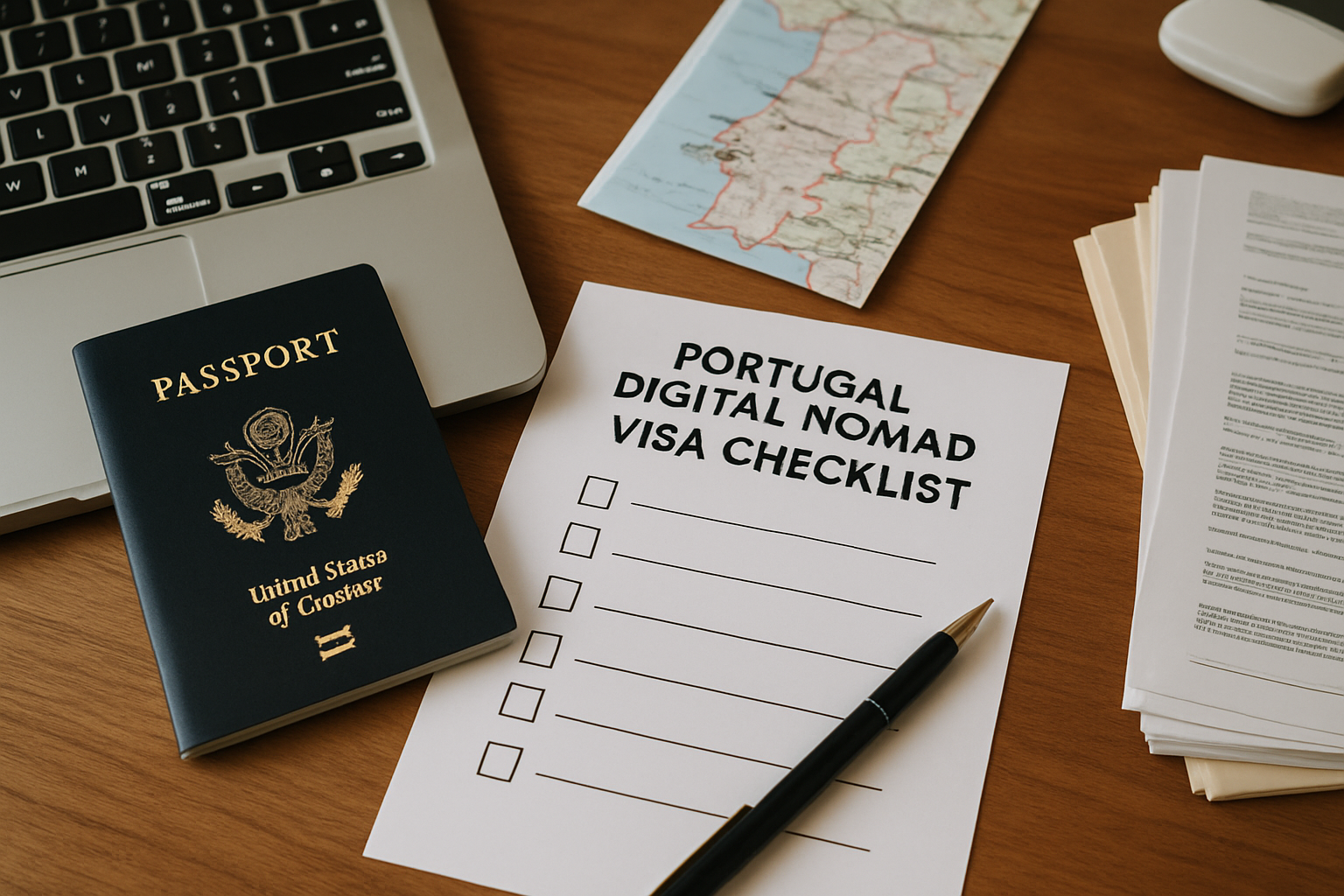
Portugal Application Readiness Checklist for U.S. Digital Nomads: Documents, Proof, Timing and Red Flags
For many U.S. remote workers, Portugal looks like the obvious next move: strong infrastructure, coastal cities, an established expat community, access to Europe, and a residence pathway commonly associated with the digital nomad or D8 visa. But the difference between “I qualify on paper” and “my application file is ready” is larger than most applicants expect.
This is a practical portugal application readiness checklist for digital nomad documents, proof, timing, and red flags. It is written for U.S.-based digital nomads preparing to apply, not for people casually comparing countries. The goal is to help you turn visa interest into a clean, reviewable document vault before you book or attend a consular appointment.
The main failure point is usually not that Portugal is impossible. It is document mismatch: income that is hard to verify, bank deposits that do not match the income story, accommodation that looks temporary or speculative, an FBI background check requested too late, insurance with unclear coverage, or an employer letter that never explicitly confirms remote work from Portugal.
If you are still comparing the broader move, start with the hidden rules in Portugal relocation for digital nomads. If you are already preparing your file, this checklist is the next layer: what to gather, how to prove it, when to time it, and what to audit before submission.
The hidden rule: Portugal visa readiness is evidence readiness
Portugal’s digital nomad residence route is designed for non-EU/EEA remote workers who earn income from outside Portugal. For U.S. applicants, that usually means proving three things at the same time:
- You have a lawful identity and clean immigration file.
- You have recurring foreign-sourced remote income that meets the current threshold.
- You have a credible plan to live in Portugal, including accommodation, insurance, and post-arrival residence steps.
Many applicants focus on the income number. That matters, but it is only one part of the review. The stronger question is: can a consular officer understand your full situation in five minutes without guessing?
Your file should answer:
- Who are you?
- Where do you legally live in the United States?
- Which consular jurisdiction applies to you?
- Who pays you?
- Is that work remote?
- Is the income recurring?
- Does the income appear in your bank statements?
- Where will you live in Portugal?
- Are you insured for the relevant period?
- Have you prepared for the residence permit stage after arrival?
A generic moving to Portugal checklist may tell you what categories exist. Application readiness means proving each category with documents that are recent, consistent, official, and easy to verify.
Start with the correct pathway and consular jurisdiction
Before you collect documents, confirm that you are preparing for the right route. Portugal has several residence options, and digital nomads sometimes confuse them.
Digital nomad route versus tourist stay
A tourist stay is not a relocation strategy. U.S. citizens can usually enter the Schengen Area visa-free for short stays, but that does not give you residence rights, long-term administrative access, or a clean path to living in Portugal. If your plan is to move, lease housing, work remotely long term, and become resident, you need to treat the process as a residence application.
Digital nomad route versus passive income route
Portugal’s digital nomad route is generally associated with remote work and foreign-sourced active income. The D7 route is more often associated with passive or stable income sources. If you are a salaried employee, contractor, freelancer, agency owner, consultant, creator, or founder earning from outside Portugal, your application file should make the remote-work profile obvious.
Apply through the right U.S. jurisdiction
U.S. applicants typically apply through the Portuguese consular jurisdiction tied to their legal U.S. residence, often using a VFS Global or consulate-specific process. This matters because appointment availability, document formatting, payment instructions, and submission rules can vary. Do not assume someone else’s checklist from another U.S. state applies exactly to you.
Your readiness file should include proof of your U.S. residence, such as a driver’s license, utility bill, lease, bank statement, or other accepted evidence matching the jurisdiction you are using.
The master Portugal application readiness checklist
Use this checklist as a working structure for your document vault. Each item should have a file name, issue date, expiration date if relevant, translation status, apostille status, and notes on whether the original must be carried to the appointment.
1. Passport
Your passport should be valid well beyond the initial visa stage. Portugal’s process does not end at the visa sticker. You may also need the passport for entry, AIMA residence steps, banking, housing, tax administration, and identity checks after arrival.
Readiness standard: clear scan of the biodata page, sufficient remaining validity, enough blank pages, and name formatting that matches your application.
Red flags: passport expiring soon, damaged passport, inconsistent middle name usage, recent legal name change not supported by documents, or a passport that will expire during the expected residence process.
2. Visa application form
The application form is the map against which your documents will be compared. If your form says one address, your bank statement says another, and your employer letter says a third, the file becomes harder to trust.
Readiness standard: completed according to the current consulate or VFS instructions, with employment, address, income, passport, and travel details matching your supporting documents.
Red flags: unexplained gaps, inconsistent employer details, wrong jurisdiction address, mismatched intended arrival date, or information copied from an outdated template.
3. Passport photos
Photos are simple until they are wrong. Check current size and format requirements before your appointment.
Readiness standard: recent physical photos meeting the required visa photo specification.
Red flags: wrong size, old photo, digital-only image when physical photos are required, casual background, or photos that do not match current appearance.
4. Proof of remote employment
If you are a salaried employee, your employer letter is one of the most important documents in the file. It should not merely say you are employed. It should show that your work can be performed remotely from Portugal and that your income is foreign-sourced.
Readiness standard: employer letter or contract confirming your role, salary, employment status, employer location, remote-work permission, and ideally permission to work while residing in Portugal.
Red flags: no explicit remote-work permission, salary omitted, unsigned letter, HR policy prohibiting international remote work, letter from a manager without company authority, or employment details that conflict with pay stubs.
5. Proof of freelance, contractor, or business income
Self-employed applicants often need a stronger evidence packet because there is no single employer letter that explains the whole income story.
Readiness standard: client contracts, statements of work, invoices, payment receipts, bank deposits, business registration records, tax filings, profit and loss reports, and a short income summary explaining how the business earns money remotely.
Red flags: one-off payments presented as recurring income, client names that do not match deposits, invoices without payment proof, cash deposits with no explanation, or a business that appears dependent on Portuguese clients before authorization.
6. Bank statements
Bank statements connect your income claims to reality. Use official statements, not screenshots.
Readiness standard: recent official statements showing your name, account identifier, balances, and deposits over the relevant period. Prepare enough months to demonstrate continuity, not just a single strong month.
Red flags: screenshots, missing applicant name, large unexplained transfers, deposits that do not match invoices or payroll, low balances immediately after large deposits, or statements from accounts that do not belong to you.
7. Tax return or IRS transcript
Tax documents help support income history. They may not perfectly match your current income if you recently changed jobs or grew a business, but any gap should be explainable.
Readiness standard: recent U.S. tax return, IRS transcript, W-2, 1099s, Schedule C, business tax records, or other documentation supporting your income profile.
Red flags: taxable income far below claimed current income with no explanation, missing self-employment schedules, or tax documents that suggest a different business than the one described in your application.
8. Accommodation proof in Portugal
Accommodation is one of the most underestimated readiness items. The question is not only whether you have somewhere to stay. The question is whether your accommodation proof looks credible for a residence application.
Readiness standard: lease, rental agreement, booking confirmation, proof of payment, full address, host or landlord details where required, and dates aligned with your intended arrival and insurance coverage.
Red flags: very short stay, fully cancellable booking, no applicant name, vague address, no payment proof, city inconsistent with your stated plan, or informal invitation with no supporting property evidence.
Applicants often struggle to secure long-term housing before visa approval because landlords may want local guarantors, deposits, or in-person viewings. This is why accommodation proof requires strategy, not just a booking.
9. FBI criminal background check
U.S. applicants commonly need an FBI Identity History Summary. Timing is critical because background checks, apostilles, mailing, and translations can create bottlenecks.
Readiness standard: recent FBI background check obtained within the accepted validity window, with apostille and translation if required under the current instructions for your application.
Red flags: state-level check used when FBI check is required, document too old, apostille missing, name mismatch, or requesting the check too close to the appointment.
10. Health insurance
Health insurance documentation should clearly show that you are covered in Portugal or the Schengen area for the required period. A vague policy summary may not be enough.
Readiness standard: certificate naming the applicant, policy dates, coverage area, and relevant benefits.
Red flags: policy starts after intended arrival, dependent names missing, travel insurance excluding residence-style stays, unclear geographic coverage, or only a payment receipt with no policy details.
11. Portuguese NIF
A NIF, or Portuguese tax identification number, is often useful early for banking, leases, tax registration, and settlement tasks. It is not the same as becoming Portuguese tax resident, but it can unlock practical steps.
Readiness standard: NIF document stored with any representative details if applicable.
Red flags: assuming the NIF alone proves residence, losing representative information, or failing to store the official document in your application vault.
12. Civil status and dependent documents
If you are applying with a spouse, partner, or children, your file becomes more complex. Civil documents need to establish family relationships clearly.
Readiness standard: marriage certificate, divorce decree, birth certificates, custody permissions, name-change documents, and apostilles or translations where required.
Red flags: inconsistent surnames, missing custody consent for minors, old certificates, unapostilled documents when apostille is required, or dependent documents not matching passport names.
13. Cover letter or intent statement
A cover letter should not be a dramatic life story. It should make the file easier to understand.
Readiness standard: concise explanation of your remote work, income source, accommodation plan, insurance, intended residence in Portugal, and intent to comply with the residence process.
Red flags: overly long narrative, claiming you will work for Portuguese clients without the right authorization, inconsistent income statements, or vague statements about “figuring it out after arrival.”
14. Document index
This is the item most applicants skip and later wish they had. A document index turns a folder of PDFs into a reviewable application file.
Readiness standard: table listing each document, file name, issue date, expiration date, translation status, apostille status, original location, and whether it was submitted.
Red flags: duplicate versions with conflicting information, missing originals, unlabeled scans, or documents scattered across email threads, phone photos, and cloud folders.
Income proof: make the money story coherent
Portugal’s digital nomad income threshold is commonly described as being linked to the Portuguese minimum wage, often four times the minimum wage for the main applicant. You should always verify the current threshold before applying because minimum wage figures and consular interpretations can change.
But the income number is only the first layer. The stronger file shows:
- Who pays you.
- Why they pay you.
- How often they pay you.
- Where the paying entity is located.
- Whether the work can be done remotely.
- Where the deposits appear in your bank statements.
- How the income relates to your tax records.
For salaried employees
Create a packet with your employment contract, employer letter, recent pay stubs, bank statements showing salary deposits, W-2 or tax transcript, and any HR remote-work approval. If your employer has approved Portugal specifically, keep that approval. Immigration permission and employer permission are separate. A visa does not force your U.S. employer to allow international remote work.
For freelancers and contractors
Create a packet with client contracts, invoices, payment confirmations, bank deposits, 1099s where applicable, tax filings, and a summary table showing client, monthly average, contract term, and payment method.
For business owners
Create a packet with business formation records, client revenue, owner draws or salary, business bank statements, personal bank statements, tax returns, profit and loss records, and a short explanation of how the business operates remotely outside Portugal.
The hidden rule is simple: income proof should tell one coherent story. If your employer letter says $8,000 per month, your bank deposits show $5,200, and your tax return shows much less without explanation, the reviewer has to do investigative work. Do not make them.
Timing: build backward from the appointment, not forward from today
Many Portugal expat mistakes begin with timing. Applicants gather documents in the wrong order, let time-sensitive documents go stale, or book accommodation before they understand processing windows.
Use a backward timeline. Start with your desired move date and work back through:
- Passport renewal if needed.
- FBI background check request.
- Apostille processing.
- Certified translation if required.
- Consular or VFS appointment availability.
- Accommodation start date.
- Insurance start date.
- Visa decision period.
- Travel window.
- Post-arrival residence appointment or AIMA process.
A practical preparation window is often several months, especially if you need to renew a passport, request federal background documentation, obtain apostilles, coordinate employer approvals, and secure accommodation from abroad. If you want a deeper pre-move document structure, use this Portugal document checklist for digital nomads alongside your consulate-specific requirements.
Red-flag audit before you submit
Before the appointment, run a document audit. This is where you catch avoidable problems before someone else does.
Name consistency
Check passport, bank statements, employer letter, tax documents, insurance policy, NIF, accommodation proof, and application forms. Watch for middle initials, married names, abbreviations, hyphenated names, and business names.
Address consistency
Your U.S. address should support your consular jurisdiction. Your Portugal address should match accommodation documents. If you recently moved, include enough proof to explain why your documents show different addresses.
Income consistency
Compare the claimed monthly income against pay stubs, deposits, contracts, invoices, tax records, and employer letters. If there is a legitimate difference, such as a recent raise or new client, explain it clearly.
Date consistency
Check that insurance, accommodation, travel plans, visa application dates, passport validity, and background check dates make sense together.
Remote-work consistency
Your file should not accidentally suggest that you plan to enter the Portuguese labor market if your route is based on foreign-sourced remote work. Be careful with cover letter wording, client descriptions, and business plans.
Common mistakes U.S. digital nomads make
- Treating the visa like travel permission. The digital nomad route is a residence process, not a vacation extension.
- Waiting too long to request the FBI background check. Processing, apostille, mailing, and translation can collide with appointment timing.
- Using screenshots instead of official statements. Screenshots look informal and may not show the necessary identifying details.
- Relying only on savings. Savings may help, but the digital nomad route usually requires ongoing remote income.
- Submitting weak accommodation proof. A short or cancellable booking may not demonstrate a credible residence plan.
- Assuming every consulate applies rules identically. Always check the process for your jurisdiction.
- Ignoring employer compliance. Your U.S. employer may have tax, payroll, data security, export control, or HR restrictions on working from Portugal.
- Forgetting post-arrival documents. The file you used for the visa may be needed again for residence, banking, housing, and tax tasks.
- Scattering documents everywhere. Email attachments, phone photos, and random cloud folders create version-control problems.
Common surprises after you start preparing
The hardest part may be proving income quality
Many applicants can earn enough but struggle to prove it neatly. A strong income file looks like an audit packet: contract, pay record, bank deposit, tax support, and explanation.
Housing from abroad is harder than expected
Landlords may prefer tenants who are already in Portugal. Some may ask for large deposits or local guarantors. Your accommodation strategy must balance credibility with financial risk.
The visa sticker is not the finish line
After approval, you still need to enter Portugal properly, preserve documents, and prepare for residence permit steps. AIMA timing can be uncertain, so your file should remain active after arrival.
U.S. tax obligations do not disappear
U.S. citizens generally remain subject to U.S. tax filing obligations even after moving abroad. Portugal tax residency may also become relevant depending on your time in the country and personal facts. Immigration readiness and tax planning are connected, but they are not the same thing.
Settlement friction to prepare for before you move
A good application file also reduces first-month friction. Portugal relocation for digital nomad applicants is not only about receiving approval; it is about arriving with the documents needed to function.
Banking
Opening or using a Portuguese bank account can depend on your NIF, proof of address, passport, U.S. bank records, and the bank’s internal rules. Store all identity, address, and financial documents together.
Housing continuation
Your first accommodation may not be your long-term home. Keep landlord communications, booking confirmations, lease offers, deposit receipts, and cancellation terms organized.
AIMA and residence processing
You may need to present or reference documents again after arrival. Keep your visa, passport, appointment notices, accommodation proof, insurance, income records, and background documentation accessible both online and offline.
Employer and client compliance
If you are employed by a U.S. company, confirm written permission for international remote work. If you are self-employed, maintain contracts showing foreign clients and remote delivery.
Tax and administrative identity
Your NIF, local address, bank account, lease, and tax profile can become interconnected. Avoid using inconsistent addresses or informal workarounds that later create administrative confusion.
First 30 and 90 days: what your application vault becomes after approval
Your document vault should not close when the visa is approved. It should convert into your Portugal settlement system.
Before departure
- Save your full application file offline and in secure cloud storage.
- Confirm visa validity dates and entry window.
- Check accommodation start date and payment proof.
- Confirm insurance start date.
- Carry originals where needed.
- Keep appointment confirmations, shipping records, and submitted versions.
First 7 days in Portugal
- Preserve entry evidence.
- Confirm phone and internet access.
- Secure continuity of address.
- Keep passport, visa, accommodation, insurance, and income proof accessible.
First 30 days
- Begin or continue banking setup.
- Organize lease continuation or longer-term housing.
- Review your tax and employer compliance position.
- Update bank statements and income records.
- Prepare for residence permit documentation.
First 90 days
- Review whether your stay may create Portugal tax residency implications.
- Maintain U.S. tax filing records.
- Update health coverage planning.
- Stabilize housing and local address records.
- Keep employer or client approvals current.
If you think of relocation as a longer-term career and lifestyle strategy, not just a visa event, this broader guide on relocation as career leverage is useful context.
Expectation gaps to fix before applying
| Expectation | Reality |
|---|---|
| If I meet the income number, I am ready. | The income must be documented, recurring, foreign-sourced, and consistent across records. |
| I can gather documents after I get an appointment. | FBI checks, apostilles, translations, and accommodation proof can take longer than expected. |
| Any travel insurance should work. | The policy should clearly name you and cover Portugal or the Schengen area for the relevant period. |
| Airbnb always works as accommodation proof. | Acceptance depends on duration, documentation quality, payment proof, and consular interpretation. |
| Savings can replace income. | Savings may support the file, but the digital nomad profile normally depends on ongoing remote income. |
| Visa approval solves employer issues. | Employer permission, payroll, tax, HR, and data rules are separate from immigration approval. |
| The visa is the finish line. | You still need to manage arrival, residence steps, banking, housing, tax, and local administration. |
A practical document vault structure
To avoid chaos, organize your Portugal file by use case rather than by random upload date. A practical folder structure looks like this:
- 01 Identity: passport, photos, driver’s license, birth certificate if needed.
- 02 U.S. residence and jurisdiction: proof of address, utility bills, lease, state ID.
- 03 Income: employer letter, contracts, pay stubs, invoices, bank deposits, tax records.
- 04 Remote-work proof: HR approval, remote policy, client agreements, role description.
- 05 Accommodation: lease, booking, payment proof, landlord messages, address evidence.
- 06 Background check: FBI result, apostille, translation, shipping records.
- 07 Insurance: policy certificate, coverage summary, payment receipt.
- 08 Portugal administration: NIF, bank documents, representative information.
- 09 Application forms: completed forms, appointment confirmations, payment receipts.
- 10 Submitted file: exact copies of everything submitted at the appointment.
Use consistent file names, such as 2026-02-15_BankStatement_Chase_Checking.pdf or 2026-03-01_EmployerLetter_RemoteWorkApproval.pdf. Label documents by issue date, not just download date.
Organize your move before you apply
Portugal application readiness is easier when your documents, checklist, and move plan live in one place. Borderless Self is built for this exact stage: when you are no longer just researching Portugal, but not yet ready to submit because your proof, timing, and red flags still need structure.
Use Borderless Self to create a relocation workspace, organize your documents in a document vault, build a country-specific checklist, and track readiness before applying or moving. You can separate identity, income, accommodation, insurance, background check, NIF, and post-arrival tasks so your application file stays reviewable instead of scattered across email, downloads, and phone photos.
Download the Borderless Self app
FAQ: Portugal application readiness for U.S. digital nomads
What documents does a U.S. digital nomad need for a Portugal visa application?
Common documents include a valid passport, visa application form, passport photos, proof of remote income, employer or client documentation, bank statements, tax records, proof of accommodation in Portugal, FBI background check, health insurance, proof of U.S. residence, NIF if available or required, and civil status documents if applying with dependents. Always confirm the current list for your consular jurisdiction.
How much income does Portugal require for the digital nomad visa?
The threshold is commonly described as a multiple of the Portuguese minimum wage, often four times the minimum wage for the main applicant. Because minimum wage figures and consular interpretation can change, verify the current requirement before applying.
Do U.S. applicants need an FBI background check?
U.S. applicants commonly need an FBI Identity History Summary rather than only a state-level background check. Request it early so you have time for apostille, translation, mailing, and validity-window management if required.
Does the FBI background check need an apostille?
It may, depending on current consular instructions. Federal documents such as FBI checks often require federal apostille handling. Confirm the requirement before your appointment and allow enough processing time.
Can I use Airbnb as proof of accommodation?
Sometimes applicants use booking platforms, but acceptance depends on the duration, documentation quality, payment proof, address clarity, and current consular expectations. A very short or fully cancellable booking can look weak for a residence application.
How many months of bank statements should I prepare?
Prepare enough recent official statements to show continuity and match your income story. The exact number may vary by consular instruction, but your goal is to prove recurring income, not just a single high balance.
Can savings replace income?
Savings can strengthen your financial profile, but the digital nomad route normally depends on ongoing remote income from outside Portugal. Do not rely on savings alone unless current official guidance for your case supports it.
What should an employer letter say?
It should confirm your role, salary, employment status, employer identity, remote-work permission, and ideally that you are permitted to work while residing in Portugal. It should be signed, dated, and consistent with pay records.
What documents should freelancers provide?
Freelancers should prepare client contracts, invoices, payment receipts, bank statements showing deposits, tax records, business registration if applicable, and a short summary explaining recurring foreign-sourced income.
Do I need a Portuguese NIF before applying?
A NIF is often useful before or during the relocation process for banking, leases, and tax administration. Whether it is strictly required at your visa stage depends on current instructions, but it is a practical readiness item.
Which Portuguese consulate should I apply through?
You typically apply through the jurisdiction linked to your legal U.S. residence. Check the relevant Portuguese consulate or VFS process for your state and do not rely only on another applicant’s checklist.
How early should I start preparing documents?
Start several months before your intended move if possible. Passport renewal, FBI checks, apostilles, translations, employer approvals, accommodation, and appointment availability can all affect timing.
What are the biggest red flags?
Common red flags include inconsistent income amounts, missing remote-work permission, weak accommodation proof, expired or stale documents, screenshots instead of official statements, name mismatches, wrong consular jurisdiction, and unclear insurance coverage.
What happens after Portugal approves the visa?
You still need to enter Portugal within the visa rules, preserve your documents, and prepare for residence permit steps, banking, housing, tax registration, healthcare planning, and longer-term settlement administration.
Conclusion: readiness is the real advantage
Moving to Portugal as a U.S. digital nomad is not just about finding the right visa category. It is about building a file that proves your identity, remote income, accommodation, insurance, background, and residence plan without confusion.
The strongest applicants do not wait until the appointment to discover gaps. They build a document vault early, track expiration dates, verify consular instructions, align bank statements with income claims, secure credible accommodation proof, and keep the same file ready for the post-arrival stage.
If Portugal is your target, treat application readiness as your first relocation skill. The cleaner your evidence, the easier it is for officials, banks, landlords, employers, and future you to understand the move you are making.