



Mexico Relocation Hidden Rules for Digital Nomads: What Nobody Tells You Before You Move
For U.S. digital nomads, Mexico looks deceptively simple. It is close, familiar, affordable compared with many American cities, and full of remote-work hubs: Mexico City, Playa del Carmen, Oaxaca, Mérida, Guadalajara, Puerto Vallarta, San Miguel de Allende, Querétaro, and beyond. You can often enter without applying for a visa in advance, find short-term housing quickly, and stay in a time zone that works for U.S. clients or employers.
But the visible version of relocation is not the full story. The real friction starts in the informal layer: discretionary entry days, consulate-by-consulate interpretation, the in-country residency exchange process, proof-of-address problems, landlord expectations, RFC and CURP timing, banking discretion, healthcare billing, and tax ambiguity. This is where many Mexico expat mistakes happen.
This article is not a generic visa overview. It is relocation intelligence for U.S. remote workers evaluating Mexico as a base. If you are researching Mexico relocation hidden rules for digital nomads: what nobody tells you before you move, the most important lesson is this: Mexico may be easy to enter, but it is not always easy to settle into cleanly.
The big hidden reality: Mexico does not have a formal digital nomad visa
Many articles describe Mexico’s Temporary Resident Visa as a “digital nomad visa.” That label is convenient, but it is not technically precise. Mexico does not currently offer a visa officially branded for digital nomads in the way some countries do. Instead, U.S. remote workers usually operate through one of two practical routes:
- Visitor status for shorter stays, tourism, exploration, or non-remunerated activity in Mexico.
- Temporary Resident status for people who want a longer legal base and can qualify through financial solvency or another eligible pathway.
The difference matters because each route creates a different settlement profile. Visitor status may be enough if you are testing Mexico for a month or two. Temporary Resident status may make more sense if you want a long lease, easier banking, repeat stays, a local administrative footprint, or a more durable base.
The mistake is assuming Mexico has designed a simple “remote worker lane” where you submit proof of U.S. income online and receive a clean nomad permit. In practice, Mexico relocation for digital nomad life is more procedural, more local, and more dependent on timing than that.
Hidden rule 1: The 180-day stay is not guaranteed
U.S. citizens can generally enter Mexico without applying for a visa in advance for tourism and certain non-remunerated activities. Historically, many travelers received up to 180 days. The hidden rule is that 180 days is a maximum, not a guarantee.
The immigration officer decides the number of days granted at entry. You may receive 180. You may receive less. If your travel pattern looks like you are living in Mexico while repeatedly entering as a visitor, or if your plans are unclear, your granted stay may be shorter than expected.
This creates a major planning risk. Do not sign a six-month lease, prepay a long Airbnb, or commit to client work based on an assumed 180-day permission. Check the number of days granted on your FMM record or digital entry record immediately after arrival.
Practical implication
If you are entering as a visitor, build your moving to Mexico checklist around the actual number of days granted, not the number of days you hoped to receive. Track your entry date, permitted stay, and exit deadline. Border runs should not be treated as a long-term residence strategy because re-entry remains discretionary.
Hidden rule 2: Consulate approval is not the same as being a resident
If you pursue Temporary Resident status, the process usually starts at a Mexican consulate outside Mexico, including consulates in the United States. If approved, you receive a visa sticker in your passport. Many first-time applicants assume that this means they are finished.
They are not finished. The visa sticker is an entry document that allows you to enter Mexico for the purpose of completing residency. After arrival, you must exchange it for a Temporary Resident card through the Instituto Nacional de Migración, commonly referred to as INM. This exchange process is often called canje.
The hidden operational deadline is usually 30 calendar days from entry. That means your first month in Mexico should not be planned like a vacation. It should be planned around immigration paperwork, appointments, copies, payment receipts, and local office requirements.
Practical implication
If you receive a Temporary Resident visa sticker, enter Mexico under the correct process. Do not accidentally enter as a tourist. Once inside Mexico, start the card exchange immediately. Avoid intercity travel that could interfere with your INM appointment or document follow-up.
Hidden rule 3: Mexican consulates in the U.S. do not behave identically
Temporary Resident Visa requirements are based on national rules and financial solvency formulas, but the lived process can vary by consulate. One consulate may interpret income thresholds, savings evidence, statement formatting, appointment availability, or employment letters differently from another.
This is one of the most important informal rules for U.S. applicants. Do not choose a consulate only because it is geographically close. Research current requirements for the specific consulate where you plan to apply. Confirm whether they accept your type of bank account, how many months of statements they require, whether statements must be stamped, and whether they want proof of employment, pension, investment income, or recurring deposits.
Digital nomads comparing Mexico with other destinations should pay attention to this procedural variability. Similar hidden-rule patterns appear in other countries too; for example, Borderless Self has covered Portugal’s hidden rules for digital nomads and the UAE hidden rules for digital nomads, where official eligibility is only one part of the relocation reality.
Practical implication
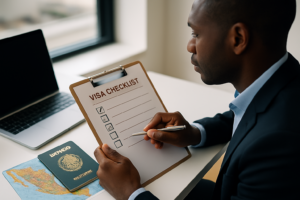
Build a consulate-specific evidence file. Prepare more than the minimum. Bring printed statements, proof of income, client contracts or employer letters where relevant, passport copies, photographs, appointment confirmations, and any form requested by that consulate. Assume the counter may care about formatting.
Hidden rule 4: Remote work is not one legal category
Many U.S. digital nomads ask, “Can I work remotely from Mexico?” The practical answer depends on what you mean by work.
Working remotely for a U.S. employer or foreign clients while physically present in Mexico is different from working for a Mexican company, joining a Mexican payroll, invoicing Mexican clients, or generating Mexico-source business activity. Visitor status does not give you a general right to work in the Mexican labor market.
Immigration permission and tax exposure are also separate questions. You might be allowed to stay in Mexico under one status while still needing tax advice because your length of stay, center of life, client location, or business structure creates reporting obligations.
Practical implication
Keep your income-source documentation clean. If your money comes from a U.S. employer, U.S. clients, or a foreign business, preserve contracts, invoices, payroll records, and tax documents. Before taking Mexican clients or creating local invoices, speak with a qualified tax or immigration professional.
Hidden rule 5: Mexico is paper-light online but paper-heavy at the counter
From the outside, Mexico can appear increasingly digital. In practice, many administrative tasks still require printed copies, exact forms, receipts, signatures, passport photocopies, proof of address, and multiple visits. A PDF on your phone may not be enough.
Expect to visit copy shops. Expect a government office, bank branch, landlord, clinic, or telecom provider to ask for a physical copy of something you thought was already digital. This is not a minor annoyance; it can delay immigration, banking, leases, and tax setup.
Practical implication
Carry both digital and printed copies of your key documents. Store encrypted cloud backups. Keep originals safe. Bring extra passport photos when dealing with official processes. Save receipts from government payments and application submissions.
Hidden rule 6: Proof of address can become a circular problem
Proof of address is one of the least glamorous but most important settlement tools in Mexico. Banks, tax offices, telecom providers, and some administrative processes may ask for it. The problem is that newcomers often do not have utilities in their own name, and many rentals keep electricity, water, gas, and internet under the landlord’s name.
This creates a circular issue: you need proof of address to open an account or complete a process, but you need a lease or account to generate proof of address.
Practical implication
Before signing a lease, ask whether the landlord can provide a utility bill, a formal lease agreement, or another acceptable address document. If you are staying in an Airbnb or informal sublet, understand that it may not work as proof of address for institutions.
Settlement friction: where U.S. digital nomads get slowed down
Mexico’s relocation friction is not evenly distributed. Some tasks are easy; others are surprisingly bureaucratic. Here is where the most common friction appears.
Immigration timing
If you pursue residency, you may need a consular appointment in the United States, then an in-country card exchange after arrival. The process is sequential. If one step slips, your move timeline slips.
Visitor stay uncertainty
If you enter as a visitor, you may receive fewer than 180 days. This can disrupt housing, travel, and work plans if you assumed a full six months.
Housing
Landlords may request a guarantor, known locally as a fiador or aval, a legal rental policy called póliza jurídica, extra deposits, proof of income, or cash payment. Foreigners may also be quoted inflated prices in tourist-heavy areas.
Banking
Opening a bank account is usually easier with a resident card, but even then it may require proof of address, tax details, U.S. tax forms, and branch-level approval. Requirements can vary between branches of the same bank.
Tax status
Immigration approval does not settle your tax position. Long stays, local economic ties, a Mexican home, Mexican clients, or a shift in your center of vital interests may create tax-residency questions. U.S. citizens also continue to have U.S. tax filing obligations.
Connectivity
Advertised internet speeds do not always reflect real reliability. Older buildings, coastal humidity, overloaded tourist zones, construction, and weak wiring can affect your workday. Always test from inside the unit.
Healthcare
Private healthcare is widely used by foreigners and can be more accessible than in the United States, but payment may be upfront. Insurance reimbursement can be slow. Hospital deposits, pre-authorization, and exclusions matter.
Language
English may be enough in parts of Roma Norte, Condesa, Playa del Carmen, Puerto Vallarta, or San Miguel de Allende. It is not enough for every lease dispute, repair issue, clinic visit, banking problem, immigration appointment, or emergency.
Housing hidden rules: do not rent like an American
Housing is where many digital nomads overpay or get trapped. The U.S. rental mindset assumes standardized leases, online listings, formal maintenance channels, predictable deposits, and clear tenant processes. Mexico is more relationship-based and locally negotiated.
A foreigner-facing apartment may look polished in photos but still have weak water pressure, loud construction nearby, poor ventilation, unreliable internet, or noise from bars, traffic, dogs, vendors, fireworks, or neighbors. Airbnb pricing is not a reliable proxy for the long-term rental market. It reflects convenience, platform fees, tourist demand, and foreign purchasing power.
Use temporary housing first
Book two to four weeks before committing to a longer lease. Walk the neighborhood at different times of day. Test the commute to coworking spaces. Check grocery access, nighttime transportation, mobile coverage, water pressure, building security, and noise.
Ask before you pay
- Who owns the property?
- Is there a written lease?
- How much is the deposit?
- When and how is the deposit returned?
- Are utilities included?
- Who pays for repairs?
- What internet provider serves the unit?
- Can the landlord provide proof of address?
- Is early termination allowed?
- Are there building rules about guests, pets, noise, or short-term stays?
If your relocation goal is financial improvement, do not evaluate rent alone. Mexico may reduce some costs, but premium neighborhoods, imported goods, private insurance, coworking, flights, U.S. storage, and short-term rentals can reduce savings. Borderless Self’s guide to what you earn versus what you keep is useful context when comparing Mexico to other bases.
Banking, RFC, and CURP: the settlement infrastructure nobody wants to learn
Three administrative concepts often appear earlier than U.S. digital nomads expect: bank accounts, CURP, and RFC.
CURP
CURP is a population registry code used in many Mexican administrative systems. Temporary residents are typically assigned a CURP. It can become useful for banking, contracts, healthcare, government processes, and service setup.
RFC
RFC is Mexico’s tax identification number. You may need it for tax registration, invoices, some financial processes, vehicle purchases, and formal economic activity. Not every short-term visitor needs to rush into RFC registration, but residents and long-stayers should evaluate it early with professional advice.
Banking
Some nomads operate with U.S. cards, Wise-style accounts, ATM withdrawals, and cash. That may work temporarily. But if you want to sign contracts, pay local services, reduce ATM dependence, or build a resident life, a Mexican bank account can help. The problem is that banks may ask for a resident card, proof of address, tax details, and compliance forms. One branch may say no while another says yes.
Document readiness before moving to Mexico
Your document stack should be prepared before you leave the United States. Mexico rewards people who arrive with clean paperwork and punishes those who assume everything can be solved from a phone.
Core documents
- Valid U.S. passport with sufficient validity and blank pages.
- Printed passport copies.
- Entry stamp or digital entry record copy after arrival.
- Temporary Resident visa sticker copy, if applicable.
- Resident card copy once issued.
- Bank statements for the consulate and rental applications.
- Income verification, such as employer letters, pay stubs, contracts, or recurring deposit records.
- Proof of remote work or business ownership.
- Travel or international health insurance policy.
- U.S. tax records.
- Driver’s license.
- Accommodation confirmation or lease.
Situational documents
- Certified birth certificate.
- Marriage certificate or divorce decree.
- Apostilled civil documents where relevant.
- Authorized translations if required for a specific process.
- Vehicle title and registration if driving into Mexico.
- Mexico auto insurance if bringing a car.
Document handling rule
Keep originals secure, carry photocopies, and store encrypted digital versions. If you are pursuing residency, keep a dedicated folder for consulate paperwork, entry records, INM receipts, payment confirmations, and appointment documents.
Common Mexico expat mistakes digital nomads should avoid
- Assuming Mexico has a dedicated digital nomad visa.
- Assuming a U.S. passport guarantees 180 days on every entry.
- Signing a six-month lease before checking the number of days granted at entry.
- Entering as a tourist after receiving a residency visa sticker.
- Missing the deadline to exchange a consular visa for a resident card.
- Choosing a consulate without checking appointment availability and document interpretation.
- Preparing only digital documents and no printed copies.
- Assuming remote income has no Mexico tax consequences.
- Taking Mexican clients without understanding immigration and tax implications.
- Signing a lease without seeing the unit in person.
- Paying large deposits informally without written terms.
- Assuming Airbnb reflects the true long-term rental market.
- Letting your U.S. phone number lapse and breaking two-factor authentication.
- Driving a U.S.-plated car into Mexico without understanding permits and insurance.
- Assuming private health insurance will work like U.S. health insurance.
- Ignoring Spanish because you live in an expat-heavy area.
- Treating border runs as a guaranteed long-term strategy.
- Assuming every bank branch, INM office, landlord, or municipality interprets rules the same way.
Common surprises after arrival
Even prepared nomads are often surprised by how much of Mexico works through local trust, paper receipts, WhatsApp, personal introductions, and branch-level discretion.
- Your entry permission may be shorter than expected.
- Some consulates are easier or stricter than others.
- Residency approval has two stages: consulate and in-country card exchange.
- Simple processes may require printed copies and multiple visits.
- Proof of address can be hard when utilities are in the landlord’s name.
- Landlords may ask for a guarantor, legal policy, or extra deposit.
- Foreigner-focused rentals may still have poor internet or water pressure.
- Bank accounts can be delayed because of branch discretion.
- RFC and CURP become important sooner than expected.
- Many services are coordinated by WhatsApp rather than formal websites.
- Hospitals may require deposits even when you have insurance.
- Noise norms may differ sharply from U.S. expectations.
- Popular nomad cities can have seasonal rent spikes.
- Imported electronics and specialty goods may cost more than expected.
- Short-term comfort in an expat bubble can delay deeper settlement tasks.
Expectation gaps: what Americans often assume versus what happens
Expectation: Mexico is easy because Americans can enter without a visa
Reality: Entry may be easy, but repeat stays, legal stay length, housing, banking, taxes, and healthcare still require planning.
Expectation: The Temporary Resident Visa is a digital nomad visa
Reality: It is a general residency pathway that can work for some remote workers, but it is not designed exclusively for digital nomads.
Expectation: Tourists automatically get 180 days
Reality: The number of days is discretionary and may be shorter.
Expectation: Once the consulate approves you, the process is done
Reality: You still need to complete the in-country resident card process.
Expectation: Remote income means no Mexico tax issue
Reality: Tax residency and income sourcing are separate from immigration status.
Expectation: Mexico is always cheaper than the United States
Reality: Some costs are lower, but foreigner-heavy neighborhoods, short-term rentals, insurance, flights, imported goods, and premium healthcare can narrow the savings gap.
Expectation: English is enough
Reality: English may work socially in expat areas, but official, medical, banking, repair, and emergency situations often require Spanish or bilingual help.
Your practical moving to Mexico checklist
1. Define your intended stay length
If you are testing Mexico for one to three months, visitor status may be operationally sufficient. If you want repeated stays, a long lease, banking, or a real base, evaluate Temporary Resident status.
2. Choose your immigration strategy before booking major logistics
If pursuing residency, identify a Mexican consulate in the United States, confirm requirements, secure an appointment, attend the appointment, enter Mexico correctly, and complete the card exchange inside Mexico.
3. Preserve your U.S. infrastructure
Keep a reliable U.S. phone number, mailing address solution, bank access, brokerage access, backup cards, tax records, and identity verification methods. U.S. two-factor authentication is not a minor detail; it can affect payroll, banking, taxes, and client platforms.
4. Use temporary housing first
Book short-term accommodation in your target neighborhood before committing. Test the lived reality, not the Instagram version of the city.
5. Build a housing due-diligence checklist
Confirm lease terms, deposit rules, utilities, internet provider, maintenance responsibility, pest issues, water supply, gas type, building rules, cancellation terms, and proof-of-address support.
6. Plan for CURP, RFC, and banking
If becoming a resident, track when your CURP is assigned and evaluate whether you need RFC registration. Research bank requirements before choosing where to open an account.
7. Get tax advice before Mexico becomes permanent
Review U.S. filing obligations, Mexico tax residency, foreign tax credits, treaty issues, self-employment income, employer compliance, and local invoicing risks.
8. Validate healthcare coverage
Confirm whether your policy covers long-term stays, routine care, emergencies, pre-existing conditions, Mexico-based providers, evacuation, and direct billing.
9. Do a connectivity audit
Ask for a speed test from inside the unit. Identify the provider. Check mobile coverage. Maintain a backup hotspot or coworking plan.
10. Do not improvise vehicle rules
If driving from the United States, verify temporary import permit rules, free zone rules, Mexico auto insurance, ownership documents, and how residency status affects vehicle legality.
First 30 and 90 days in Mexico: a practical sequence
Before arrival
- Choose visitor status or residency strategy based on stay length and risk tolerance.
- Confirm whether Temporary Resident requirements are realistic for your selected consulate.
- Secure U.S. phone, mail, banking, and tax-access continuity.
- Book temporary housing rather than a long lease.
- Prepare printed immigration, financial, insurance, and identity documents.
Days 1 to 7
- Confirm the number of days granted at entry if entering as a visitor.
- If entering with a residency visa, confirm the entry was processed correctly.
- Begin the canje process immediately if pursuing residency.
- Buy a Mexican SIM or eSIM while preserving U.S. authentication access.
- Test neighborhood safety, transit, groceries, and internet.
- Identify nearby clinics, pharmacies, coworking spaces, and emergency contacts.
Days 8 to 30
- Complete or advance your INM card exchange process.
- Avoid domestic travel that interferes with immigration appointments.
- Shortlist long-term neighborhoods based on actual daily experience.
- Inspect apartments in person and request written lease terms.
- Confirm whether a landlord can support proof-of-address needs.
- Start evaluating RFC, CURP, banking, and tax-advisor needs.
Days 31 to 60
- Open a local bank account if your status and documents allow.
- Set up stable internet, mobile backup, and coworking contingency.
- Establish a primary doctor, dentist, or clinic option.
- Create a local payment routine using cards, cash, transfers, and apps.
- Review your tax position if the stay is becoming more than temporary.
Days 61 to 90
- Decide whether Mexico is a short-term base, seasonal base, or residency base.
- Document travel dates and immigration status for future renewals or tax analysis.
- Review lease satisfaction before extending.
- Improve your Spanish-language administrative capability or hire support.
- If on visitor status, plan departure or status strategy before your stay expires.
City choice is not enough: neighborhood choice matters more
Digital nomads often choose Mexico by city: Mexico City for culture and flights, Playa del Carmen for beach life, Oaxaca for food and community, Mérida for safety reputation, Guadalajara for tech and urban life, Puerto Vallarta for coast and expat infrastructure. But the hidden rule is that neighborhood choice often matters more than city choice.
Safety, noise, walkability, internet reliability, flooding, heat, water pressure, transit, and pricing can change block by block. A neighborhood that works for nightlife may not work for deep work. A beautiful apartment may be unusable if construction starts at 7 a.m. or the internet drops during U.S. business hours.
Use community reports carefully. Online forums and digital nomad community signals can help identify patterns, but they do not replace testing the building, street, and routine yourself.
Healthcare: accessible does not mean automatic
Private healthcare in Mexico can be one of the country’s strongest advantages for U.S. digital nomads. Doctors, dentists, specialists, and labs may be more accessible and more affordable than in the United States. But there are hidden rules.
Some providers require upfront payment. Some hospitals require deposits. Some international insurance plans require pre-authorization. Travel insurance may exclude routine care, long stays, pre-existing conditions, or residency-like patterns. Prescription availability may differ from the United States, and brand names may change.
Before relying on any policy, check direct billing, reimbursement rules, emergency coverage, evacuation coverage, pre-existing condition treatment, prescription rules, and provider networks in your specific city.
Driving into Mexico: solve the vehicle question before the border
Flying into Mexico avoids several vehicle complications. Driving a U.S.-plated car creates legal layers: temporary vehicle import permits, free zones, border zones, insurance, vehicle ownership documents, and resident-status implications.
U.S. auto insurance usually does not satisfy Mexican liability requirements. If you plan to live outside border or free zones, you may need a temporary import permit. If you become a resident, vehicle rules can become more complicated depending on status and location.
Do not bring a car and plan to “figure it out later.” Research the rules before crossing and keep your title, registration, permit documents, and Mexico insurance organized.
Build your relocation workspace before you move
The easiest Mexico move is not the one with the fewest rules. It is the one where the rules are sequenced correctly. Before you apply for residency, book a long lease, or drive across the border, create a relocation workspace that keeps your documents, deadlines, housing checks, and status decisions in one place.
With Borderless Self, you can create a country-specific relocation workspace, organize your passport, visa, bank statements, insurance, lease, tax records, and vehicle documents in a document vault, build a Mexico-specific checklist, and track readiness before applying or moving. Download the Borderless Self app to turn your Mexico plan from a collection of tabs and screenshots into a structured move file.
FAQ: Mexico relocation for U.S. digital nomads
Does Mexico have a digital nomad visa?
No. Mexico does not currently have a visa officially branded as a digital nomad visa. Many remote workers use visitor status for shorter stays or Temporary Resident status for a longer legal base.
Can U.S. citizens live in Mexico for 180 days without a visa?
U.S. citizens can often enter Mexico without applying for a visa in advance for tourism or non-remunerated activities, but the permitted stay is decided at entry. It may be up to 180 days, but it is not guaranteed.
Is the 180-day Mexico tourist stay guaranteed?
No. The immigration officer decides how many days to grant. Always verify your permitted stay after entry.
Can I work remotely from Mexico for a U.S. company?
Many digital nomads do remote work for U.S. employers or clients while physically in Mexico, but immigration status, income source, tax residency, and employer compliance should be reviewed carefully. Working for a Mexican company or Mexican clients can create different issues.
Can I work for Mexican clients while on visitor status?
Do not assume you can. Local work, Mexican-source income, or employment-like arrangements may require proper authorization and tax registration. Get professional advice before taking Mexican clients.
What is the difference between visitor status and Temporary Resident status?
Visitor status is generally for shorter stays and does not create the same administrative base as residency. Temporary Resident status can support longer stays and may make banking, leasing, and administrative processes easier, but it requires a formal process.
Do I apply for Temporary Resident status before entering Mexico?
In most cases, yes. The process usually starts at a Mexican consulate outside Mexico. After approval, you enter Mexico with the visa sticker and exchange it for a resident card through INM.
What happens after a Mexican consulate approves my Temporary Resident Visa?
You receive a visa sticker that allows you to enter Mexico for residency processing. You must then complete the in-country exchange process to receive your Temporary Resident card.
How long do I have to exchange the visa sticker for a resident card?
The exchange process generally must be started within 30 calendar days of entering Mexico with the residency visa. Treat this as a real operational deadline.
Why do Mexican consulates have different income requirements?
Financial solvency rules are tied to formulas and interpretation. Consulates may differ in thresholds, documentation preferences, appointment availability, and how they review statements or income proof.
Do digital nomads in Mexico need an RFC?
Not every short-term visitor needs one immediately, but residents, long-stayers, people invoicing locally, or people opening certain accounts may need to evaluate RFC registration with a tax professional.
Do foreigners in Mexico need a CURP?
Temporary residents are typically assigned a CURP, and it can be useful for many administrative processes. It becomes part of your settlement infrastructure.
Can I open a Mexican bank account as a U.S. digital nomad?
It depends on the bank, branch, and your documents. Residency, proof of address, tax information, and compliance forms may be required. Branch discretion is common.
What documents do landlords in Mexico ask from foreigners?
They may ask for passport, proof of income, deposits, references, a guarantor, a legal rental policy, or additional security because you are foreign. Requirements vary widely.
Is Airbnb a good way to find long-term housing in Mexico?
Airbnb is useful for temporary arrival housing, but it is not always a good proxy for long-term rent. It often reflects tourist pricing and platform convenience.
Do I owe taxes in Mexico if my income comes from the United States?
Possibly, depending on your facts. Tax residency, source of income, center of life, length of stay, and business structure all matter. U.S. citizens also retain U.S. tax filing obligations. Get cross-border tax advice.
Can I bring my U.S. car to Mexico if I become a resident?
Vehicle rules can become complex. Temporary import permits, free zones, insurance, and residency status all matter. Research before driving into Mexico.
Is private healthcare in Mexico enough for digital nomads?
Private healthcare can be strong and accessible, but insurance assumptions often fail. Verify coverage, direct billing, emergency rules, reimbursement, and hospital deposit requirements.
What should I do in my first 30 days after moving to Mexico?
Confirm your immigration status and permitted stay, start canje if applicable, secure mobile access, test your neighborhood, avoid premature leases, organize proof of address, and begin evaluating banking, RFC, CURP, healthcare, and tax needs.
Conclusion: Mexico is manageable if you plan for the informal system
Mexico can be an excellent base for U.S. digital nomads: close to home, culturally rich, time-zone friendly, and full of livable cities. But the relocation challenge is not just choosing Mexico City versus Oaxaca or visitor status versus Temporary Resident status. The challenge is understanding how the procedural layer works in real life.
The hidden rules are where the move succeeds or fails: discretionary entry days, consulate variation, the 30-day residency exchange window, proof-of-address friction, landlord negotiation, banking discretion, tax ambiguity, healthcare billing, and neighborhood-level quality of life.
If you treat Mexico as “easy” and improvise, you may create avoidable problems. If you treat it as a real relocation system with local interpretation, document sequencing, and settlement dependencies, it becomes much more manageable. The smartest digital nomads do not just move to Mexico; they build a clean operating base before they arrive.