
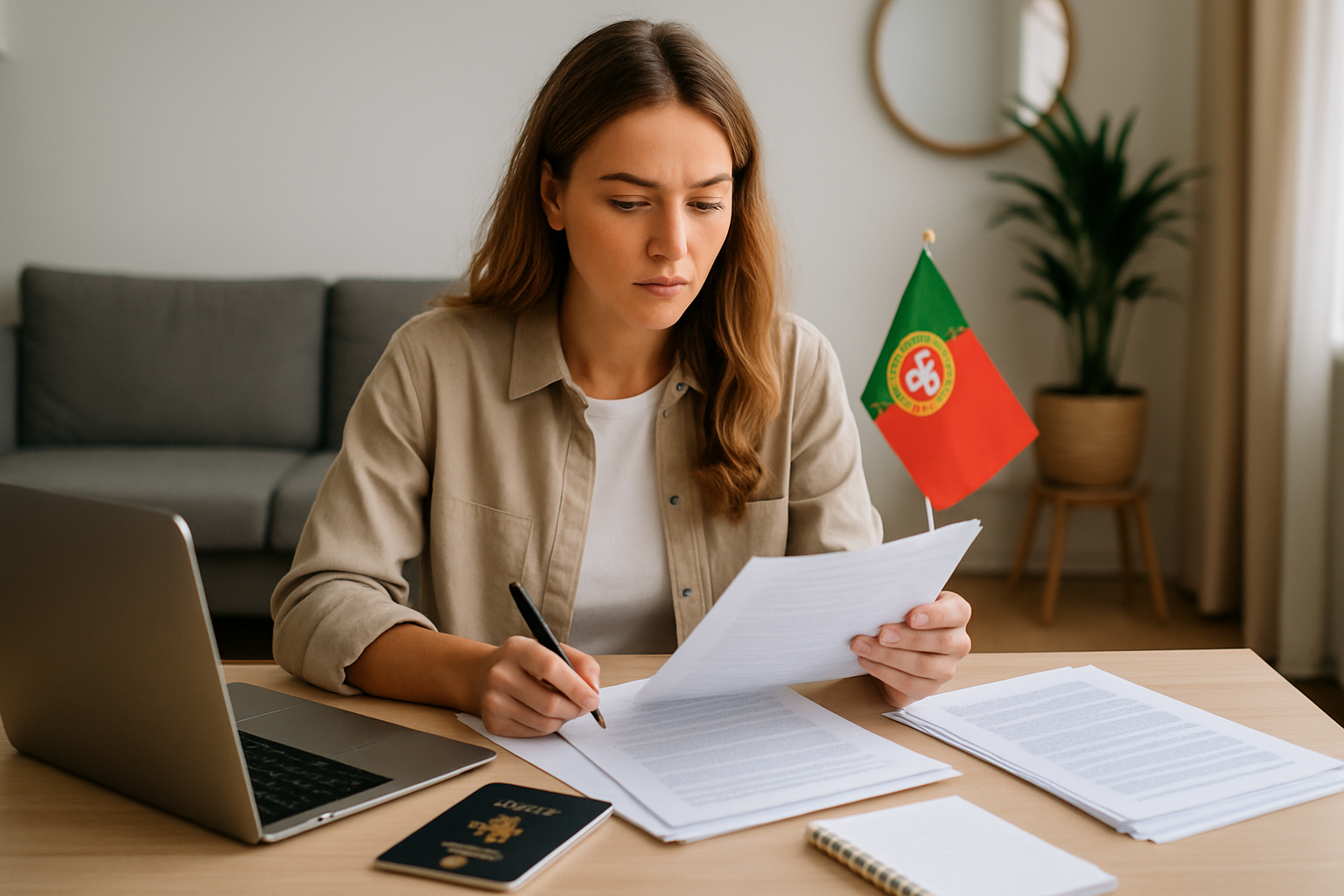
Documents to Organize Before Moving to Portugal: A Vault Checklist for Digital Nomads
For a U.S.-based digital nomad, Portugal relocation is not just a visa project. It is an evidence project. You are proving identity, income, remote work eligibility, financial stability, health coverage, accommodation, tax history, and administrative continuity across several systems that do not always talk to each other: the consulate, VFS, AIMA, banks, landlords, accountants, insurers, healthcare offices, and sometimes schools, airlines, or pet import authorities.
This guide is for the preparation stage: the point where Portugal is no longer just an idea, but you are not yet ready to submit the final application or board the plane. If you are looking for “documents to organize before moving to portugal a vault checklist for digital no…” this is the practical relocation vault version: what to collect, what to scan, what may need apostille or translation, what goes stale, and what you will probably be asked for after the visa checklist is already finished.
If you are still comparing visa routes, income expectations, and the hidden administrative rules of Portugal relocation, start with our guide to Portugal relocation for digital nomads. Once you know Portugal is the likely next base, your next move is not another inspirational video about Lisbon or Madeira. It is building a document vault that can survive consulate requests, AIMA delays, landlord questions, banking compliance, tax planning, and the first 90 days after arrival.
Why a document vault matters more than a normal moving checklist
A normal moving to Portugal checklist tells you to get a visa, book accommodation, buy insurance, and open a bank account. Useful, but incomplete. The problem is that each of those tasks creates a document trail, and Portugal relocation often depends on whether that trail is clear, recent, official, and consistent.
The hidden rule is simple: the visa checklist is not the settlement checklist. A document that satisfies your initial application may not satisfy AIMA later. A bank may ask for source-of-funds evidence not listed by the consulate. A landlord may want U.S. tax returns, employment letters, bank statements, deposits, or guarantor information. An accountant may need prior-year returns and state tax details. A healthcare registration desk may ask for different insurance or residence evidence than you expected.
For digital nomads, this gets more complicated because income can be fragmented. You may have a U.S. employer, multiple clients, an LLC, 1099 income, W-2 income, Stripe deposits, Wise transfers, brokerage assets, or retained business earnings. If that story is scattered across apps and screenshots, it becomes harder for a reviewer, landlord, banker, or accountant to understand quickly.
Your relocation vault should become your operating system for Portugal: a secure, organized place where every important document is stored, labeled, tracked, refreshed, and connected to a specific use case.
The core structure of a Portugal relocation document vault
Do not build one giant folder called “Portugal.” That will collapse under pressure. Build a vault by use case. The goal is to find the right document in seconds when someone asks for it, and to know whether it is current, apostilled, translated, printed, or still pending.
Recommended vault folders
- 00 Admin Tracker: master spreadsheet or checklist with document status, expiration dates, apostille status, translation status, original location, and intended use.
- 01 Identity: passport, passport photos, driver’s license, Social Security evidence, secondary IDs.
- 02 Civil Status and Family: birth, marriage, divorce, name-change, adoption, custody, children’s records.
- 03 Portugal Visa and Immigration: application forms, appointment confirmations, consulate checklist, FBI background check, accommodation, insurance, financial means.
- 04 Remote Work and Income: contracts, employer letters, client agreements, invoices, payslips, bank deposits, business documents.
- 05 Taxes: U.S. federal returns, IRS transcripts, state returns, 1099s, W-2s, estimated tax records, business tax records.
- 06 Banking and Financial Life: bank statements, brokerage statements, retirement accounts, source-of-funds evidence, credit reports.
- 07 Housing: Portugal lease, booking confirmations, landlord letters, rent payments, U.S. lease or mortgage, landlord references.
- 08 Healthcare and Insurance: international health insurance, travel insurance, medical records, prescriptions, vaccination records.
- 09 Portugal Setup: NIF, Portuguese bank documents, local lease, utilities, AIMA appointment, Portuguese address tracker.
- 10 Driving and Mobility: U.S. driver’s license, International Driving Permit, driving record, insurance history, license exchange notes.
- 11 Education and Dependents: diplomas, transcripts, school records, vaccination records, special education records, parental permissions.
- 12 Pets: microchip, rabies vaccination, veterinary certificate, USDA endorsement, airline documents.
- 13 Emergency and Continuity: emergency contacts, power of attorney, healthcare proxy, embassy details, password recovery instructions.
- 14 Refresh Before Appointment: documents likely to expire or need updated versions within 30 to 90 days.
The tracker is as important as the files
Your vault needs more than PDFs. It needs a tracking layer. For every document, track:
- Document name
- Owner, especially for couples or families
- Issuing authority
- Issue date
- Expiration date or “stale after” date
- Whether an apostille may be needed
- Whether a certified translation may be needed
- Where the original is stored
- Where the digital copy is stored
- Which process it supports: visa, AIMA, bank, housing, tax, healthcare, school, driving, pet entry, or renewal
This is how you prevent one of the most common Portugal expat mistakes: having the right document somewhere, but not being able to prove quickly that it is current, complete, official, and connected to the request in front of you.
Identity documents: the foundation of every process
Start with identity. Every other document is weaker if your name, date of birth, passport number, or address history is inconsistent.
Prepare these documents
- U.S. passport with sufficient validity
- Second passport, if applicable
- Color scan of passport identification page
- Scans of visa pages and entry stamps after travel
- Passport photos in both physical and digital format
- U.S. driver’s license
- Social Security card or SSN confirmation
- Global Entry or TSA PreCheck details, if relevant
Hidden rule: name consistency is not a detail
Portugal bureaucracy often rewards continuity. Your passport, FBI background check, tax returns, bank statements, contracts, marriage certificate, and insurance should tell the same identity story. If you changed your name through marriage, divorce, court order, gender marker update, adoption, or another legal process, keep the supporting documents in the same folder as your identity records.
Do not assume a reviewer will infer that “Alexandra M. Jones,” “Alex Jones LLC,” and “A. Jones” are the same person. Help them connect the dots.
Civil status and family documents
Even solo digital nomads should organize civil documents before leaving the United States. If Portugal later asks for originals or certified copies, retrieving them from a storage unit, family member, county office, or state vital records department can become expensive and slow.
Prepare these documents if relevant
- Birth certificate
- Marriage certificate
- Divorce decree
- Legal name-change order
- Adoption records
- Custody order
- Parental consent letters
- Children’s birth certificates
- Dependent relationship evidence
Apostille and translation awareness
U.S. documents intended for official use in Portugal may need an apostille. Apostilles confirm document authenticity for international use; they do not translate the document. A document may need both an apostille and a certified translation into Portuguese, depending on the receiving authority and purpose.
Another hidden rule: the issuing authority matters. Federal documents, such as an FBI Identity History Summary, follow a different apostille route from state-issued records like birth, marriage, divorce, or name-change documents. Do not treat U.S. notarization as the same thing as an apostille.
Portugal visa and immigration documents
Portugal’s digital nomad route is commonly associated with the D8 visa and residence pathway for remote workers, but exact document lists can vary by consulate, applicant profile, and appointment channel. U.S. applicants often work through VFS Global or a Portuguese consular jurisdiction based on U.S. residence. Always save the exact checklist version you used, because requirements can change while you are in process.
Prepare these documents
- Visa application form
- Appointment confirmation
- Passport and passport copies
- Passport photos
- FBI Identity History Summary or other required criminal record document
- Authorization for criminal record consultation in Portugal, if required
- Proof of legal U.S. residence, if not a U.S. citizen
- Proof of accommodation in Portugal
- Proof of financial means
- Proof of remote work income
- Proof of health insurance
- Travel itinerary or flight reservation, if required
- Visa fee receipts
- Consulate or VFS checklist saved as a PDF
Documents that can go stale quickly
Many applicants focus on collecting documents but forget timing. These documents are often safest when recent:
- FBI background check
- Bank statements
- Employment letters
- Client letters
- Proof of accommodation
- Insurance certificates
- Remote work authorization letters
- Financial means evidence
AIMA appointment uncertainty can also create a second freshness problem. You may receive a visa, arrive in Portugal, and then wait for residence processing or updated instructions. If documents expire during that window, you may need refreshed versions. This is why your vault should have a “refresh before appointment” folder.
Remote work and income evidence
For Portugal relocation for digital nomad applicants, income proof is not just about showing money. It is about showing a coherent remote work model. A reviewer should be able to understand who pays you, where that payer is based, what work you perform, whether it can be done remotely, and whether income is stable enough for residence.
Build income proof in layers
- Layer 1: Legal basis of work. Employment contract, client contract, service agreement, founder documents, operating agreement, or freelance agreement.
- Layer 2: Remote permission. Employer remote work authorization letter or contract language confirming remote work is allowed.
- Layer 3: Income generation. Payslips, invoices, client statements, monthly revenue summaries, profit and loss statements.
- Layer 4: Money movement. Bank statements showing deposits from employer, clients, payroll processors, or business accounts.
- Layer 5: Tax confirmation. W-2s, 1099s, federal returns, business returns, IRS transcripts, estimated tax records.
Freelancers and founders need extra clarity
If you are self-employed, do not rely on a collection of invoices and screenshots. Create a simple income narrative:
- Client A contract leads to monthly invoice A
- Invoice A matches deposit A on bank statement
- Deposits appear in business or personal account
- Income is reflected on 1099s, tax returns, or accounting records
- Work is performed remotely for non-Portuguese clients
This also helps later with Portuguese banks, accountants, and housing applications. Digital nomads often discover that a landlord or bank wants more structured income proof than the visa checklist did.
Tax documents Americans should save before moving
U.S. citizens and tax residents carry U.S. tax obligations with them. Portugal relocation can also create Portuguese tax residency exposure, depending on your days in country, residence ties, and facts. Your vault should make it easy to brief a tax professional without digging through email archives from three years ago.
Prepare these tax records
- Last two to three years of U.S. federal tax returns
- IRS tax transcripts
- State tax returns
- W-2s
- 1099s
- Estimated tax payment records
- Business tax returns, if applicable
- Bookkeeping exports
- Accountant contact details
- Foreign bank account reporting notes, if relevant
- State exit documentation, if you are leaving a high-friction state
Tax records can support visa income proof, banking source-of-funds reviews, accountant onboarding, and foreign earned income exclusion or foreign tax credit planning. They can also help clarify whether you have truly changed your life footprint or simply added Portugal on top of an unchanged U.S. state presence.
As you plan the numbers, remember that international relocation is not only about gross income. It is about what you keep after rent, tax, healthcare, banking, compliance, and currency friction. For a broader lens, see Borderless Self’s guide on what you earn versus what you keep.
Banking and financial life documents
Opening or using financial accounts in Portugal may require more than a passport and a NIF. Banks are compliance-heavy environments. They may ask about source of funds, address, tax identification, income, employment, and the reason for opening the account.
Prepare these documents
- Recent official bank statements as PDFs
- Brokerage statements
- Retirement account statements
- Proof of savings
- Proof of source of funds
- Credit card statements, if useful for address proof
- Loan statements
- Mortgage or lease documents in the United States
- Credit report, if useful for landlords
- U.S. tax identification details
- NIF certificate or application receipt, once obtained
Bank statement quality matters
Do not rely on cropped screenshots from a banking app. Official PDF statements should show your name, institution, account identifiers, dates, balances, and deposits. If you redact information, do it carefully and keep an unredacted version available for official review if required.
Also protect your access. If your U.S. phone number stops working abroad, two-factor authentication can lock you out of banks, payroll systems, IRS accounts, insurance portals, and your own document storage. Before departure, confirm that your authentication methods will work in Portugal.
Housing documents: more than a booking confirmation
Accommodation evidence is one of the most underestimated parts of a moving to Portugal checklist. It can affect visa approval, AIMA readiness, NIF address updates, banking, tax administration, and your first-month stability.
Prepare these documents
- Portugal lease
- Temporary accommodation booking
- Landlord letter
- Proof of rent payment or deposit
- Landlord identification or property documentation, if required
- U.S. lease or mortgage documents
- Reference letters from previous landlords
- Proof of income for landlords
- Renter’s insurance, if applicable
Settlement friction: landlords may ask like banks
In competitive markets such as Lisbon, Porto, the Algarve, and Madeira, landlords may request income proof, deposits, guarantors, tax returns, employment letters, or bank statements. This can surprise U.S. digital nomads who expected a lease process closer to booking a long-term Airbnb.
Keep housing documents separate from visa documents. Your visa accommodation file may prove where you intend to stay. Your housing search file should help you win a real lease after arrival.
Healthcare and insurance documents
Health insurance can appear at multiple stages: visa application, entry, residence appointment, private care access, and possible healthcare registration later. Travel coverage that looks sufficient for a trip may not be the same as coverage expected for residence preparation.
Prepare these documents
- International health insurance certificate
- Travel insurance certificate, if separate
- Full policy terms
- Coverage territory description
- Deductibles and exclusions
- Proof of premium payment
- Vaccination records
- Prescription list
- Medical summaries
- Dental and vision records
- Mental health treatment summaries, if relevant
- Provider contact details
If you take prescription medication, especially controlled substances, carry documentation from your doctor and verify availability before moving. Save both the medical summary and the prescription details in your vault.
Portugal setup documents: NIF, bank, AIMA, and address history
Once Portugal becomes operational, you will start generating local documents. Save them immediately. Your post-arrival documents often become the evidence for your next administrative step.
Prepare or save these documents
- NIF certificate or application receipt
- Portuguese bank account opening documents
- Portuguese bank statements
- Portuguese lease or accommodation proof
- Utility contracts
- Local insurance policies
- AIMA appointment confirmation
- AIMA emails or notices
- Portuguese address history tracker
- Mobile phone contract
- Coworking membership, if relevant
Hidden rule: track every address you use
Portugal systems may ask for a local address before you have permanent housing. You might use one address for a NIF, another for a bank, another for temporary accommodation, and another for your long-term lease. Track which address was used for which process and on what date. Inconsistent addresses are not always fatal, but unexplained address changes can create confusion.
Driving, pets, dependents, and emergency continuity
These categories are easy to ignore until they become urgent. Add them to the vault early, even if you are not sure they apply.
Driving and mobility
- U.S. driver’s license
- International Driving Permit
- Driving record
- Auto insurance claim history
- License exchange research notes
- Vehicle import documents, if applicable
A U.S. driver’s license is not automatically enough for long-term driving in Portugal. Check current rules for license exchange and timing after residence.
Families and dependents
- School transcripts
- Diplomas
- Vaccination records
- IEP or special education records
- Letters of recommendation
- Custody documents
- Parental consent letters
- Dependent financial support evidence
Families face compounded document complexity. Each person needs identity, medical, immigration, and relationship evidence. Schools may request translated or certified records.
Pets
- Microchip certificate
- Rabies vaccination record
- Veterinary health certificate
- USDA endorsement documents
- Airline pet reservation
- Medication records
- EU pet passport, if obtained later
Pet import paperwork is time-sensitive. Track it separately from human immigration documents so rabies timing, veterinary certificates, endorsement windows, and airline requirements do not get buried.
Emergency and continuity
- Emergency contacts
- Power of attorney
- Healthcare proxy
- Will or estate documents
- Insurance beneficiary records
- Password manager emergency access instructions
- Copies of key cards and IDs
- U.S. embassy contact information in Portugal
Your vault should still work if your laptop, phone, wallet, or passport is lost abroad. Keep secure offline copies, encrypted backups, and emergency access instructions for a trusted person.
Expectation gaps that cause Portugal expat mistakes
The biggest problems usually come from reasonable assumptions that turn out to be wrong. These are the expectation gaps to correct before you apply or move.
Expectation: “The visa checklist is the whole relocation checklist.”
Reality: The visa checklist is one stage. AIMA, banks, landlords, healthcare, taxes, driving, schools, pets, and renewals can all create additional document requests.
Expectation: “Digital copies are enough.”
Reality: Digital copies are essential, but originals, printed copies, apostilles, certified translations, and wet signatures may still matter.
Expectation: “My income is obvious from my bank app.”
Reality: A reviewer may need contracts, invoices, deposits, tax forms, and employer letters connected into one coherent proof packet.
Expectation: “I can handle apostilles later.”
Reality: Apostilles can become a bottleneck, especially for federal documents or state records requested close to an appointment date.
Expectation: “Once the visa is approved, paperwork is over.”
Reality: Some of the most frustrating document requests happen after arrival, especially around AIMA, banking, housing, tax, and renewals.
Common surprises after arrival in Portugal
- Portugal can feel digitally modern in daily life but still require printed documents and original papers for important bureaucracy.
- A bank, landlord, or accountant may ask for more detailed income proof than the consulate did.
- AIMA or another authority may request updated documents after the visa has already been issued.
- The same U.S. document may need several versions: original, scan, apostilled copy, translated copy, and a simple reference copy.
- Health insurance that was fine for travel may not be ideal for residence or long-term coverage expectations.
- Proof of accommodation can be harder than expected if landlords hesitate to sign leases before you have a residence card or local income history.
- U.S. two-factor authentication can become a relocation risk if your U.S. mobile number stops working.
- Portuguese administrative language may use unfamiliar terms such as fiscal number, declaration, certificate, proof of means, or residence evidence.
If you want a broader view of how relocation decisions intersect with lifestyle, work structure, and administrative friction, Borderless Self also tracks patterns from global movers and communities such as r/expats relocation discussions.
First 30 and 90 days: how the vault should evolve
Your document vault should not stop at departure. Portugal relocation is a moving system. The vault should evolve before departure, during the first month, and through the first 90 days.
Before departure
- Confirm all visa-related documents are saved, printed, and backed up.
- Keep originals in carry-on luggage, not checked baggage.
- Download offline copies of passport, visa, insurance, accommodation, and income proof.
- Confirm access to U.S. bank, payroll, IRS, insurance, and vault accounts using two-factor authentication that works abroad.
- Prepare a small arrival folder for border entry, accommodation check-in, bank appointments, and emergencies.
- Save the consulate or VFS checklist version used for the application.
First 30 days in Portugal
- Save your entry stamp, boarding pass, and arrival evidence.
- Update the vault with your actual Portugal address, lease, receipts, and local contact details.
- Store NIF, bank, insurance, and housing documents as soon as they are issued.
- Track any AIMA appointment communication and document refresh instructions.
- Create a local services folder for mobile phone, utilities, coworking, healthcare, and transport.
- Record which Portuguese address was used for each system.
Days 31 to 90
- Review which visa documents may expire before a residence appointment.
- Prepare an AIMA or residence appointment packet with updated accommodation, income, bank, insurance, and criminal record documents if required.
- Start organizing Portuguese tax residency and accounting documents if your stay may create local obligations.
- Document rent payments, housing stability, and address changes.
- If driving, review license exchange timing and save any required driving records.
- Refresh income evidence if you changed employers, clients, or business structure during the move.
Common document mistakes to avoid
- Treating the visa checklist as the entire moving to Portugal checklist.
- Starting the FBI background check too late and ignoring apostille timing.
- Saving only screenshots instead of full official PDF statements.
- Not keeping originals accessible after uploading visa documents.
- Letting bank statements, employment letters, insurance certificates, or accommodation proof go stale.
- Failing to organize documents by process, causing panic when a landlord, bank, or AIMA request appears.
- Assuming U.S. notarization is equivalent to an apostille.
- Forgetting name-change evidence.
- Using inconsistent addresses across NIF, bank, visa, tax, insurance, and housing without tracking them.
- Not saving proof that remote work is authorized by the employer or compatible with client contracts.
- Ignoring U.S. tax records until a Portuguese accountant or bank asks for them.
- Failing to create emergency access if a laptop or phone is lost abroad.
- Not checking requirements by Portuguese consular jurisdiction before building the final application packet.
Practical vault workflow: what to do this week
If you are preparing now, do not try to perfect everything in one sitting. Build the system first, then fill it.
Day 1: Create the vault structure
Create the folder categories listed above. Add a tracker with status fields for requested, received, scanned, apostilled, translated, uploaded, printed, packed, and refreshed.
Day 2: Collect identity and tax records
Download passport scans, driver’s license scans, Social Security evidence, federal tax returns, IRS transcripts, W-2s, 1099s, and state returns.
Day 3: Start slow documents
Order certified copies of birth, marriage, divorce, custody, adoption, or name-change records. Start the FBI background check process early and confirm whether apostille timing matters for your route.
Day 4: Build income evidence
Collect contracts, employer letters, client agreements, invoices, payslips, bank deposits, and business records. Create an income narrative that connects the evidence.
Day 5: Prepare housing and insurance folders
Save accommodation confirmations, lease drafts, landlord messages, insurance quotes, final policy certificates, coverage terms, and proof of payment.
Day 6: Review recency and expiration
Move documents that may go stale into a refresh folder. Add reminders for bank statements, insurance certificates, employment letters, criminal background checks, accommodation proof, and passport validity.
Day 7: Make the print and carry plan
Create a print-ready visa packet and a smaller arrival packet. Decide which originals travel in your carry-on and which trusted person has emergency access.
Build your relocation workspace before you move
A Portugal move is easier to manage when your documents, checklist, and readiness status live in one place. Borderless Self is designed for that exact preparation gap: the messy period between deciding to move and being fully settled.
Use it to create a Portugal relocation workspace, organize your documents in a structured document vault, build a country-specific checklist, track missing items, and monitor readiness before applying or moving. The goal is not to collect documents for the sake of it. The goal is to know what is missing before a consulate, bank, landlord, accountant, or AIMA appointment exposes the gap.
Download the Borderless Self app and build your Portugal document vault before you book your visa appointment or finalize your move.
FAQ: Portugal document vault for U.S. digital nomads
What documents should a U.S. digital nomad organize before moving to Portugal?
Organize identity documents, civil records, visa documents, FBI background check, remote work income proof, tax returns, bank statements, accommodation proof, health insurance, NIF records, healthcare documents, driving records, emergency documents, and any family or pet paperwork.
Is the Portugal visa checklist enough for relocation preparation?
No. The visa checklist is only one stage. You may need additional documents for AIMA, banking, housing, taxes, healthcare, driving, renewals, and family administration after arrival.
Which U.S. documents may need an apostille for Portugal?
Common candidates include FBI background checks, birth certificates, marriage certificates, divorce decrees, adoption records, custody documents, and name-change orders. Requirements depend on the receiving authority and use case.
Do I need certified translations of U.S. documents?
Some U.S. documents may need certified translation into Portuguese. An apostille confirms authenticity; it does not replace translation. Always check the receiving authority’s current requirements.
How recent should my FBI background check be?
Recency expectations can vary by consulate, appointment timing, and process. Because criminal background checks can become stale, start early enough to handle apostille timing but close enough to the application window that the document remains useful.
What income documents should digital nomads keep for Portugal?
Keep employment contracts, remote work authorization letters, client contracts, invoices, payslips, bank statements showing deposits, profit and loss records, business formation documents, 1099s, W-2s, and tax returns.
How should freelancers prove income?
Freelancers should connect contracts to invoices, invoices to bank deposits, and deposits to tax records. A simple monthly income summary can help reviewers understand variable income quickly.
What tax documents should Americans save before moving to Portugal?
Save federal tax returns, IRS transcripts, state returns, W-2s, 1099s, estimated tax payment records, business returns, bookkeeping exports, and accountant contact details.
What documents do Portuguese landlords commonly ask for?
Landlords may ask for passport, NIF, income proof, employment letter, bank statements, tax returns, deposit proof, references, guarantor information, or evidence of residence status.
What documents are useful for opening a Portuguese bank account?
Useful documents include passport, NIF, proof of address, U.S. tax identification, income proof, employment or business records, bank statements, and source-of-funds evidence.
Should I keep original documents with me when moving?
Yes. Keep critical originals in carry-on luggage, not checked baggage. Also keep high-quality scans and secure offline backups.
How should I organize documents for my AIMA appointment?
Create a separate residence appointment packet with passport, visa, appointment confirmation, accommodation proof, income proof, bank evidence, insurance, criminal record documents if required, NIF, and any updated documents requested by AIMA.
What are the most common document mistakes U.S. expats make?
Common mistakes include starting background checks too late, relying on screenshots, ignoring apostilles, forgetting name-change documents, using inconsistent addresses, losing access to U.S. accounts, and assuming the visa approval ends the paperwork.
What pet documents are needed before relocating from the U.S. to Portugal?
Pets typically need microchip records, rabies vaccination records, veterinary health certificates, USDA endorsement documents, airline pet reservations, and medication records. Timing is critical.
How do I track expiring documents?
Use a tracker with issue dates, expiration dates, stale-after dates, renewal reminders, and the process each document supports. Flag documents that may need refreshing within 30 to 90 days.
Conclusion
Portugal relocation for digital nomads is not won by having a folder of random PDFs. It is won by building a document system that can answer questions before they become delays: Who are you? Where does your income come from? Can you work remotely? Where will you live? Are you insured? What is your tax history? Which address did you use? Where is the original? Does this need an apostille or translation? Is it still recent?
The best time to build that system is before you apply, before you move, and before the first urgent request arrives. A well-built Portugal document vault turns relocation from a scramble into a managed process. It helps you avoid common Portugal expat mistakes, respond faster to settlement friction, and carry one coherent evidence trail from the United States to your new base in Portugal.
