

Early Risk and Immigration: From Exile to a New Start
Changpeng “CZ” Zhao was born in 1977 in Jiangsu, China, into a family of educators. His father, a university instructor, fell victim to China’s Cultural Revolution – labeled a “pro-bourgeois intellectual” and sent to the countryside. Seeking a safer future, Zhao’s father left for a Ph.D. program in Canada in 1984. It took years for the family to obtain passports and visas, but in late 1989, 12-year-old CZ emigrated with his mother to join his father in Vancouver. This move came at a trade-off: the family exchanged their established status in China for an immigrant’s uncertainty. In Canada, CZ’s mother, once a schoolteacher, could only find factory work, and his father subsisted on a modest university stipend. Zhao himself took up work early – pumping gas, flipping burgers at McDonald’s – contributing to family income during his teens. These humbling experiences instilled an inherited adaptability: the family recalibrated their status for opportunity, and CZ grew up navigating life between cultures as “a normal immigrant kid learning to adapt”.
That adaptability soon extended to education. A gifted student, CZ was admitted to McGill University in Montreal to study biology – a practical choice encouraged by family friends – but he quickly realized his passion lay in computer science. He switched majors after one semester, preferring the burgeoning tech field to a stable medical career. Even in college, CZ was strategically minded: he worked summers and part-time during semesters, managing to graduate (or nearly graduate) without student debt. In fact, he avoided borrowing by earning enough in co-op jobs and with help from family, a decision that gave him financial flexibility early on. This frugality and work ethic were a form of generational risk management – he minimized burden on his immigrant family while positioning himself for the next opportunity.
Leaving School for Opportunity: Credentials vs. Experience
A defining decision point came as CZ neared the end of his computer science program. In his third year, he landed an internship with a company in Tokyo that was developing trading software for the Tokyo Stock Exchange. The chance to work in Tokyo – “a dream… it’s like from the future” as he later described it – was compelling enough that CZ never returned to finish his McGill degree. Instead, he extended his internship into a full-time role, prioritizing hands-on experience over the diploma. This decision carried a hidden cost. When the company offered to hire him permanently in Japan, CZ discovered that a bachelor’s degree was legally required for a Japanese work visa. In an improvisational fix, he enrolled in an online program (“the American College of Computer Science”) to obtain a quick credential. This maneuver – arguably a form of credibility transfer – highlights how Zhao navigated formal constraints. He traded the prestige of McGill for real-world skills, then scrambled to reacquire the paper credential on the side. (It is likely he needed the degree to qualify for a Japanese working visa, a requirement for foreigners, though he has noted this was during the 2000 dot-com boom when non-traditional degrees were easier to obtain.)
Armed with a degree and visa, Zhao moved to Tokyo around 2001. There, he joined Fusion Systems, a startup of mostly American expats, writing ultra-fast order-matching software for stock brokers. The role was demanding and technical, all about shaving milliseconds off trades – an early exposure to the constraint of efficiency that would later define his work in crypto exchanges. After a couple of years, Fusion Systems Japan was acquired by a Nasdaq-listed firm for ~$50 million. Zhao, then in his mid-20s, didn’t profit from the sale (he was a salaried engineer, not a founder). But he gained something more educational: a front-row view of a merger gone wrong, as clashing cultures led the new parent to implode a subsequent venture within a year. That failure taught CZ about management pitfalls and likely planted seeds of entrepreneurial ambition.
In late 2001, another inflection point arrived. Bloomberg in New York recruited Zhao to develop trading systems (specifically futures trading platforms). Despite the post-9/11 uncertainty, he seized the opportunity and relocated to the United States on a work visa (likely an H-1B or NAFTA TN, given his Canadian citizenship – informed speculation). At Bloomberg, CZ gained blue-chip experience: he rose to lead teams and was promoted three times in two years. For four years he enjoyed the resources of a large firm – “fancy offices, fish tanks, free food” – a stark contrast to startup life. Yet this period was one of stability through motion. Zhao was still moving geographically and within corporate hierarchies, absorbing best practices. By 2005, at age 27, he had a formidable resume across three countries. But he also sensed that to grow further, he’d need to step out on his own. The trade-off looming: leave a stable high-paying job for the chaos of entrepreneurship back in Asia.
Sea Turtle Return: Entrepreneurship in Shanghai and a Pivot
In 2005, CZ made the bold decision to return to China, joining a wave of returnee entrepreneurs (nicknamed “sea turtles”) bringing overseas experience back home. Along with five former colleagues (from Tokyo and New York), he co-founded a fintech startup in Shanghai, later known as Fusion Systems Ltd. This venture was a case study in rooted mobility: Zhao was Chinese-born but had to re-assimilate as a foreign-educated tech executive in a rapidly changing Shanghai. He was the only Mandarin speaker on the founding team, yet even he had to brush up on business Chinese. The startup’s strategy was to “bring Wall Street trading technology into China”, selling high-performance systems to Chinese stock brokers and exchanges.
However, they immediately hit a regulatory wall. The company was registered as a WFOE (Wholly Foreign-Owned Enterprise), which made Chinese financial institutions reluctant or outright unable to contract with them. This was an early lesson in constraint navigation. The team had effectively miscalculated how local rules about foreign businesses would limit their market. In response, they pivoted away from their core mission – instead of fintech for brokers, Fusion Systems did general IT projects for any clients they could get. For CZ, this pivot was a humbling recalibration: cutting-edge finance tech had to take a backseat to keeping the lights on. Still, the company survived and even thrived modestly as an IT consultancy, reportedly counting Goldman Sachs and Credit Suisse among its clients for trading systems.
During this time, Zhao gained management experience and local credibility. But he hadn’t forgotten the bigger picture. His willingness to uproot himself remained intact, and he stayed alert for the next paradigm shift. That shift came around 2013, in the form of Bitcoin.
All-In on Bitcoin: Selling Home and Starting Over (Again)
2013 was a turning point for CZ’s career – one that exemplifies trade-offs, not triumphs. While playing poker in Shanghai, he first heard about Bitcoin from friends like Bobby Lee (who was starting BTCC, China’s first crypto exchange). Fascinated, Zhao spent months studying this new “magic internet money” and the blockchain technology behind it. By late 2013, he was convinced that crypto was the future of finance – and that he needed to be part of it. But this conviction demanded sacrifice. In a move that startled friends and family, CZ decided to sell his apartment in Shanghai and invest practically all his net worth into Bitcoin. The property sold for about US$1 million; he began buying BTC in early 2014 at an average price around $600. It was, in effect, a complete reboot of his career and finances, a choice Zhao himself framed in stark terms: at 35 years old, he didn’t want to miss the next big wave, even if it meant a step backward in stability.
Along with liquidating assets, CZ moved his family to Tokyo in 2014 while he personally bounced between crypto hubs. (It’s likely he chose Japan as a base for its more favorable stance on crypto at the time, and perhaps ease of entry for a Canadian passport holder – this is an informed speculation, as he mentioned that after selling the apartment, his family lived in a Tokyo rental while he traveled for work.) By moving out of China, Zhao hedged against potential crackdowns and positioned himself globally. Indeed, after China’s central bank issued early warnings on Bitcoin in late 2013, being geographically diversified was prudent.
Zhao’s first roles in the crypto industry were far from CEO-level. In 2014, he joined Blockchain.info (now Blockchain.com) as head of development – essentially a VP of Engineering – and relocated briefly to Europe. The London-based wallet company had no office and paid staff in Bitcoin, an arrangement CZ credits for teaching him the value of remote, crypto-native operations. He lasted about 6–8 months there before cultural changes (and a power struggle he observed among the founders) prompted him to leave. No sooner had he become “available” than two rival Chinese exchanges vied for his expertise. OKCoin, based in Beijing, offered CZ the Chief Technology Officer position with 5% equity, and competitor BTCC (run by his friend Bobby Lee) countered with a higher offer, which OKCoin quickly matched. Zhao chose OKCoin, meaning another relocation to Beijing in late 2014. It was a whirlwind year: from Shanghai to London to Beijing, from developer to C-suite, Zhao was constantly recalibrating his trajectory.
At OKCoin, Zhao finally wielded significant influence (managing the platform technology and even international outreach). But this stint, too, was short-lived – about 8 months. He clashed with the CEO over business ethics and practices (such as how promotions and fee discounts were handled). By early 2015, CZ decided to quit, once again sacrificing a prestigious role on principle. This departure could have been a major setback, but it set the stage for Zhao’s next entrepreneurial move. Two developers from his network quit their jobs the same day and approached him to start a new exchange together. Sensing opportunity, CZ agreed – this time positioning himself as CEO from the start.
Resilience and Recalibration: From Failed Exchange to SaaS Provider
The plan in 2015 was to launch a Bitcoin exchange in Japan, filling the void left by the Mt. Gox collapse. Zhao and his small team even built a prototype in days by forking open-source code, showcasing it to potential investors. Here we see credibility transfer in action: CZ leveraged his trading systems know-how to answer tough technical questions, impressing investors with the platform’s speed and his expertise. However, those same investors doubted the team’s ability to succeed as a consumer exchange in Japan – CZ wasn’t a Japanese speaker, and local competition loomed. Instead, they suggested a pivot: sell the exchange software to other companies.
Taking this advice, Zhao recalibrated the venture into a B2B software-as-a-service model. They quickly signed their first exchange client in Japan for $360,000, which covered his team’s salaries and validated the new business model. By mid-2015, CZ had effectively created Bijie Tech, an exchange technology provider based back in Shanghai (the name wasn’t widely public then, but this was the genesis of the company). Over the next two years, “we signed up 30 different exchange clients,” he later recalled. This phase was one of stability through motion: Zhao had found a steady revenue stream by moving behind the scenes, licensing white-label exchange infrastructure across Asia. It was profitable, routine, and somewhat under the radar – a stark change from the public-facing excitement of running an exchange.
Yet, once again, external forces intervened. In early 2017, Chinese authorities began clamping down on cryptocurrency trading platforms. By March 2017, most of Bijie Tech’s exchange clients in China were shut down by regulators. Because CZ was only a software vendor (not running the exchanges), he wasn’t personally targeted. But his business was suddenly crippled, as client after client disappeared. By May 2017, Zhao faced a tough decision: pivot or perish. Shuttering Bijie Tech would squander the talented team and tech stack he’d built. Instead, he chose to bet on himself one more time – by launching his own exchange. In his words, “by April, May, we were like, figure out how to pivot…Why don’t we do it ourselves?”.
“Exchange the World”: The Birth of Binance and Borderless Expansion
CZ’s team of ~20 rallied to create a new crypto exchange focused on crypto-to-crypto trading (no fiat, to avoid regulatory banks). Lacking venture capital and short on time, Zhao turned to an emerging idea: an Initial Coin Offering. In mid-2017, ICOs were a novel way to crowdfund by issuing exchange tokens. Attending a conference in June 2017, CZ saw the frenzy firsthand – a lesser-known Chinese founder had raised $15 million in days with just a white paper. If he could do it, Zhao thought, so could I. By June 14, 2017, he announced to his team that they would do an ICO for “Binance,” the exchange they envisioned. (The name fused “Binary” + “Finance,” reflecting a digital-native financial platform.) Zhao’s reputation in the crypto community – boosted by his prior roles at Blockchain.info and OKCoin – lent credibility to the offering. Within weeks, Binance raised roughly $15 million worth of crypto from a global base of 20,000 contributors. In July 2017, Binance went live, and within eight months it became the world’s largest cryptocurrency exchange by trading volume.
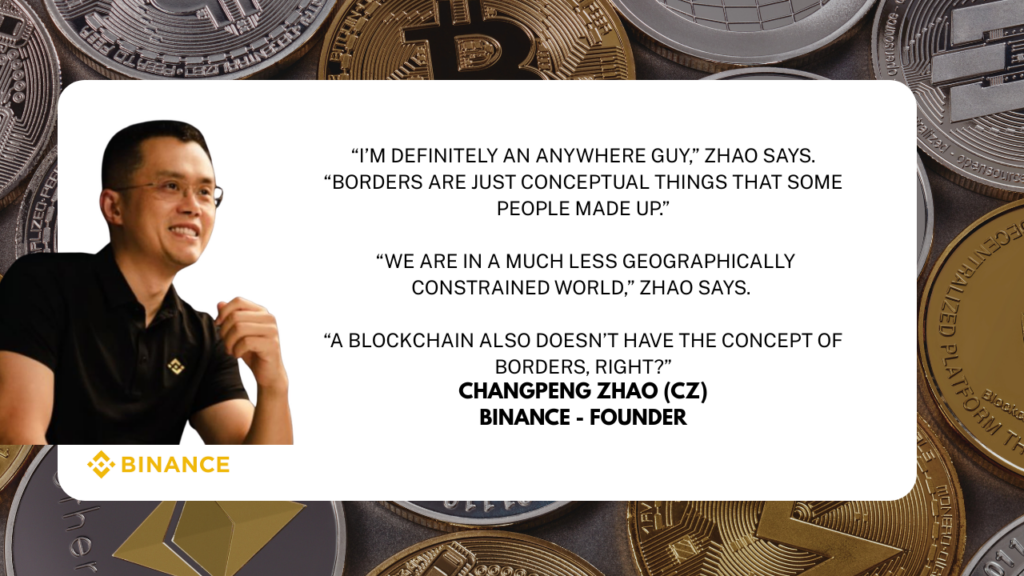
This rapid success was not just timing or luck; it was also the result of Zhao’s strategic fluidity. From day one, Binance was essentially borderless. The company was registered in Hong Kong, but it served users everywhere and had a distributed workforce. That design was deliberate, as CZ’s worldview rejected the idea of being tied to any single jurisdiction. “I’m definitely an ‘Anywhere’ guy,” he said. “Borders are just conceptual things that some people made up.” This philosophy was soon stress-tested. In September 2017, only a month after Binance’s launch, China banned cryptocurrency exchanges outright, causing Binance to shut down its China platform and relocate operations abroad. Zhao quickly moved key staff to Japan, a neighboring market with a warmer stance at the time. By early 2018, however, Japanese regulators also signaled that Binance was operating without a proper license, forcing another exit. In the span of a few months, Binance had to close up shop in two countries – a daunting scenario for most CEOs.
Zhao, drawing on his past migrations, took it in stride. This “constraint mobility” became part of Binance’s DNA. “Before, there was no regulation, and now there is – it happens all the time,” he said of the shifting legal landscape. “When that happens, you’ve just got to comply. When you think it’s too strict, and there’s no business to do, you leave.”. This pragmatic (if controversial) approach saw Binance ping-pong across jurisdictions: after Japan, CZ announced an intended base in crypto-friendly Malta, then later set up entities in places like Singapore and Jersey. By 2019, he famously declared that Binance had no headquarters at all – it was an everywhere-and-nowhere company. Structurally, Binance operated via a network of affiliates (Binance Holdings in Cayman, Binance Ltd in BVI, etc.), which critics argued was meant to obfuscate responsibility. But from Zhao’s perspective, it aligned with the decentralized ethos of crypto and his own borderless identity. In a way, CZ was applying the same principle to the company that guided his personal journey: keep options open, move whenever necessary, stability through motion.
This pattern of relentless relocation earned CZ a reputation as a “nomadic CEO”. Personally, he embodied minimalism to stay mobile – he famously did not own a house, a car, or luxury goods despite his billionaire status. For him, true wealth was the freedom to move and start anew without baggage. It’s telling that after leaving China, he never set down long-term roots in any one country until recently. In 2021–2022, amidst increasing regulatory scrutiny from the U.S. and Europe, Zhao gravitated to the United Arab Emirates, whose government embraced crypto innovation. He even purchased his first home in Dubai in 2022 as a show of commitment to a pro-crypto city (after years of living out of hotels). By 2023, it was reported that CZ obtained UAE citizenship, adding to his Canadian passport – a development that underscores his multi-national life. (Dual citizenship can be seen as another asset in a borderless career, though it also raised eyebrows when U.S. authorities considered him a flight risk.)
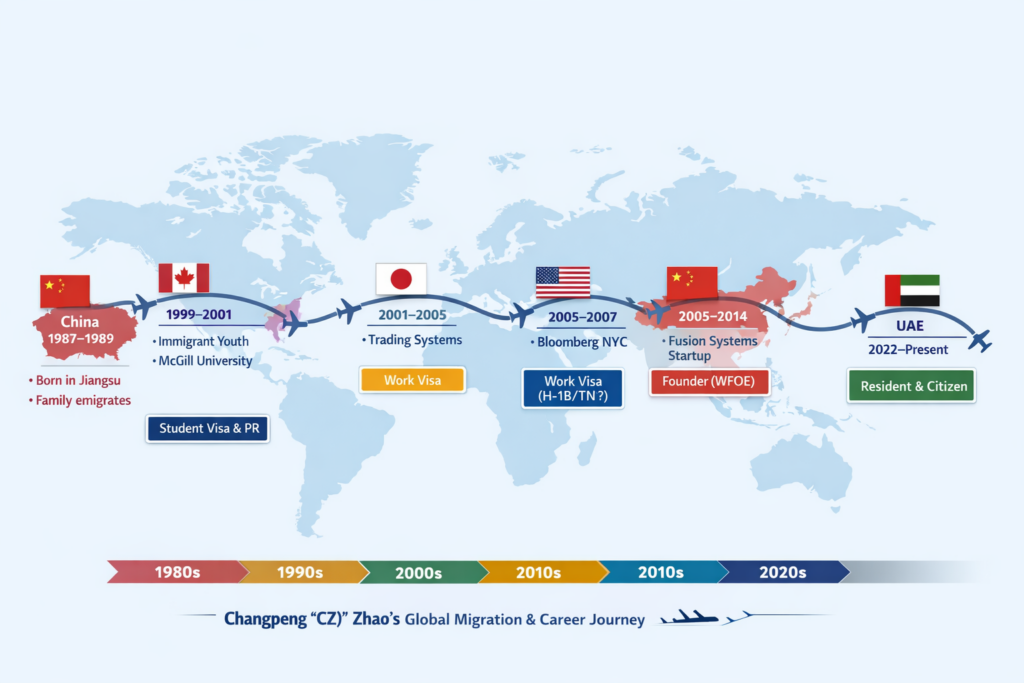
Timeline: CZ’s Geographic & Professional Journey
To visualize Zhao’s journey, the timeline below highlights his major moves, ventures, and likely immigration statuses at each juncture. Each relocation came with key decision points and trade-offs that shaped his path:
Timeline: Key inflection points in Changpeng Zhao’s life and career, illustrating his geographic mobility and career pivots. Visa/residency statuses are inferred (e.g., student-dependent immigrant in Canada; work visas in Japan and the U.S.; founder via WFOE in China; international entrepreneur with Canadian passport; UAE resident/citizen in later years).
Legacy of a Borderless Self
CZ’s story is not a straight line of triumphs, but a zigzag of decisions under uncertainty. He gave up the comfort of familiar places multiple times: leaving China as a boy, leaving Canada for an internship, leaving a stable Wall Street career for a startup, and selling everything to dive into crypto. Each move involved losing something to gain something. Zhao lost geographic rootedness – but he gained a global vision. He lost short-term security – but each gamble put him closer to the forefront of a new industry. Migration profoundly shaped how he views opportunity and risk. He credits growing up across China and Canada with giving him a long-term mindset and an immunity to parochial biases. “We are in a much less geographically constrained world… A blockchain also doesn’t have the concept of borders, right?” he mused, explaining why Bitcoin resonated with him.
Through the lens of the Borderless Self, Changpeng Zhao’s career can be seen as a case study in constraint navigation and status recalibration. He repeatedly transferred his credibility to new contexts – from Canada to Japan to the U.S. and back to Asia – building on each experience. His identity as an immigrant turned out to be an asset: it made him comfortable with being an outsider and gave him the courage to enter unknown markets. Of course, there are downsides to being “anywhere.” Zhao’s detractors note that operating outside strict jurisdictions can invite compliance lapses – a reality that caught up with him in 2023 when U.S. prosecutors charged Binance with AML failures, leading CZ to pay a $4 billion fine and step aside as CEO. In a final irony, the man with no address had to remain in one country (the U.S.) pending his legal proceedings. Even this chapter, however, is not the end but another recalibration. As of 2026, CZ reflects on finding purpose beyond his role at Binance, emphasizing health and family while remaining an industry advisor.
Changpeng Zhao’s journey illustrates how a borderless life actually unfolds: not as a tidy narrative of inspiration, but as a series of calculated moves and adaptive responses. He navigated invisible barriers (like visa rules and licensing laws) by staying flexible on location and relentless on execution. He traded stability in one system for credibility in another, turning each setback into a new start. In a world increasingly without borders, CZ’s career is a blueprint for leveraging a global mindset – built beyond borders by continually choosing motion over comfort, and strategy over sentiment.
